
Memorials
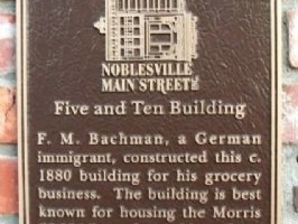
F. M. Bachman, a German immigrant, constructed this c.1880 building for his grocery business. The building is best known for housing the Morris 5&10¢ Store, located here from the 1920s to the 1950s.
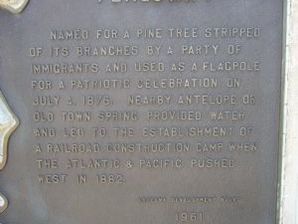
Named for a pine tree stripped of its branches by a party of immigrants and used as a flagpole for a patriotic celebration on July 4, 1876. Nearby Antelope or Old Town Spring provided water and led to the establishment of a railroad construction camp when the Atlantic & Pacific pushed west in 1882.

Jobs in the iron mines of the Penokee Range! Ample land to homestead!
News of the good life on the Penokee Iron Range brought Finnish immigrants here as early as 1887. By 1900, native born Finns were the largest ethnic group seeking a new life on the Range.
The Finns did not settle around the mining “locations” or in populated communities. They preferred rural areas reminiscent of their old country homeland. Here they could own land, maintain their language and traditions, and create their “... Read More

This is the childhood home of Southern author Flannery O'Connor, who resided here from the time of her birth in 1925 until 1938. The townhouse, located in Savannah, Georgia, is undergoing restoration to reflect the era, but is partially open to the public.
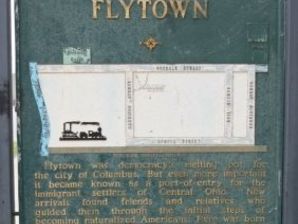
Flytown was democracy’s melting pot for
the city of Columbus. But even more important
it became known as a port-of-entry for the
immigrant settlers of Central Ohio. New
arrivals found friends and relatives who
guided them through the initial steps of
becoming naturalized Americans. Here was born
a feeling of comradeship that led to patriotic
loyalty that knew no division. Seventeen
nationalities contributed of their knowledge and experience to the community spirit and culture of Flytown. This... Read More
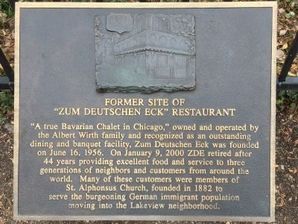
”A true Bavarian Chalet in Chicago,” owned and operated by the Albert Wirth family and recognized as an outstanding dining and banquet facility, Zum Deutschen Eck was founded on June 16, 1956. On January 9, 2000 ZDE retired after 44 years providing excellent food and service to three generations of neighbors and customers from around the world. Many of these customers were members of St. Alphonsus Church, founded in 1882 to serve the burgeoning German immigrant population moving into the... Read More

First named French Mills in the 1790's by immigrant settlers who came from lower Canada to work in the Robertson and Buchanan Mills on the Salmon River. In 1817 it was renamed Fort Covington in honor of Brigadier General Leonard Covington, who died during the American - British War of 1812. General Covington was mortally wounded on November 11, 1813 at the battle of Chrysler's Farm in Williamsburg Ontario, Canada.

In Commemoration of
Fort Crook
Established July 1, 1857 by Lieut' George Crook and Command for the protection of the immigrants and settlers. Later occupied by Capt John W Gardner and Capt McGregor.
The boundaries of this fort were designated as one mile in every direction from the flag pole.
Abandoned June 1, 1869

On this site in September 1864 an immigrant train, under the command of Capt. James L. Fisk, bound for the gold fields of Montana, was besieged by hostile Sioux Indians, despite the fact that an armed escort of 50 U. S. Cavalrymen had been provided for its protection. To defend themselves, the wagon train, and their stock, a breastwork of prairie sod was built which enabled them to successfully resist attacks for 14 days until a rescue party conducted them to Fort Rice. A number of civilians... Read More