
Memorials

Immigrants from six continents settled in the rolling hills and prairies of Clay County in the vicinity of the Missouri River.
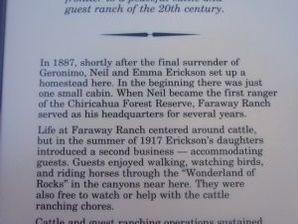
Faraway Ranch represents a
transition from the wild, unsettled
frontier to a peaceful cattle and
guest ranch of the 20th century.
—————————
In 1887, shortly after the final surrender of Geronimo, Neil and Emma Erickson set up a homestead here. When Neil became the first ranger of the Chiricahua Forest Reserve, Faraway Ranch served as his headquarters for several years.
Life at Faraway Ranch centered around cattle, but in the summer of 1917 Erickson's daughters introduced a second... Read More

In 1805 Bernard de Marigny began the subdivision of his plantation, creating the first suburb below the original city. As Americans settled up-river, immigrants and free persons of color settled in Faubourg Marigny.
Faubourg Marigny Improvement Association
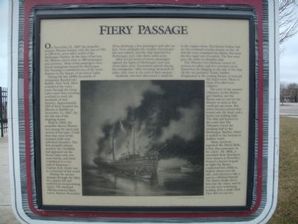
On November 21, 1847 the propeller steamer Phoenix burned, with the loss of 190 to 250 lives, seven miles north of the Sheboygan Harbor. At the time of her loss the Phoenix carried close to 300 passengers and crewmen. Most of the passengers were Dutch immigrants bound for Sheboygan. Her burning is considered one of the worst disasters in the history of the Great Lakes.
During the late 1840s thousands of immigrants flooded into Buffalo, New York. Most considered the water route through the... Read More
1f03.jpg?itok=nh_znLRP "Sampaiii. \"Filipino American WWII Veterans Memorial (Front).\" Wikimedia Commons, 27 Feb. 2018, https://commons.wikimedia.org/wiki/File:Filipino_American_WWII_Veterans_Memorial_(Front).png")
Designed by Cheri Gaulke and unveiled by Eric Garcetti, president of the Los Angeles City Council, in November 2006, this is the first monument dedicated to the 250,000 Filipinos and 7,000 Filipino American soldiers who fought in WWII for the United States.
There are busts of Jean Sibelius, noted composer of “Finlandia”, Elias Lonnrot, doctor and author of the epic poem, “Kalevala,” Johan Vilhelm Snellman, statesman, and Johan Ludvig Runeberg, national poet and author of the Finnish national anthem, “Maame.”
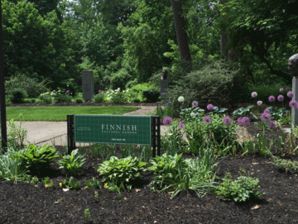
This memorial garden commemorates Finnish heritage and the journey of Finnish immigrants to America. There are busts of important figures in Finnish heritage that are placed throughout the garden. These figures include Aleksis Kivi, Jean Sibelius and Elias Lonnrot.

1. Fifty-two "Sloopers," the first group of Norwegian immigrants to North America, departed from Stavanger on July 4, 1825. Fifty-three arrived in New York City on October 9, a baby having been born en route. 2. Their 54 feet long slop, the "Restauration," exceeded the maximum of sixteen passengers allowed under U.S. maritime law. The boat was therefore impounded, the captain arrested, and a $3,150 fine levied. However, President John Quincy Adams pardoned them. 3. The... Read More
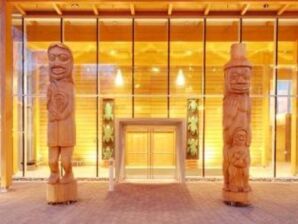
The University of Victoria in British Columbia established the First Peoples House in 2010 to act as a cultural, academic, and social center dedicated to the school's Indigenous students and heritage. People entering the building must respect the land's ancestors and are encouraged to enter with a humble heart and a clear mind.
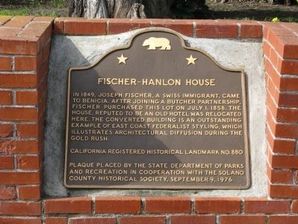
In 1849, Joseph Fischer, a Swiss immigrant, came to Benicia. After joining a butcher partnership, Fischer purchased this lot on July 1, 1858. The house, reputed to be an old hotel was relocated here. The converted building is an outstanding example of East Coast federalist styling, which illustrates architectural diffusion during the Gold Rush.