
Memorials

Swiss Immigrant
Founder of New Helvetia
The beginning of Sacramento
Builder of Sutter’s Fort
A man of vision and compassion
who deserves the respect
and gratitude
of Americans and Swiss

This typical Wisconsin frame farmhouse was built by the son of a German immigrant on a forty-acre parcel. The land was later used as a truck farm and mink ranch. In 1950 an old chicken house on the property was converted to serve as the first Catholic Church in Monona. The farmhouse became the rectory.
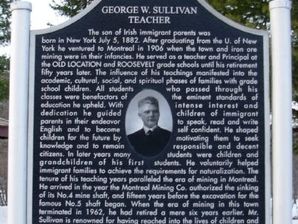
The son of Irish immigrant parents was born in New York July 5, 1882. After graduating from the U. of New York he ventured to Montreal in 1906 when the town and iron ore mining were in their infancies. He served as a teacher and Principal at the OLD LOCATION and ROOSEVELT grade schools until his retirement fifty years later. The influence of his teachings manifested into the academic, cultural, social, and spiritual phases of families with grade school children. All students who passed through... Read More

This Fountain Commemorates The Religious,
Social, Agricultural, Economic, And Political
Contributions Of Early German Immigrants
To The Establishment And Growth
Of The Colony Of Georgia.
erected And Dedicated in 1989
By Their Descendants
Members Of
German Heritage Society
German Friendly Society
Georgia Salzburger Society

This monument was erected in 1991 by the German-Bohemian Heritage Society to commemorate the immigrants to this region from the German speaking western rim of present-day Czechoslovakia. They emigrated from the counties of Bischofteinitz, Mies and Taus in the province of Pilsen, as shown on the European map and settled in the townships sketched on the U.S. map. Around the base in the granite slabs are inscribed the over 350 immigrant family names as they were approximately spelled when the... Read More

After the Civil War, dozens of immigrant families moved into the area. The village of Germantown started here, later known as Perry Hall.
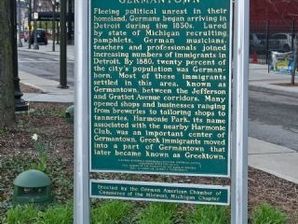
Fleeing political unrest in their homeland, Germans began arriving in Detroit during the 1830s. Lured by state of Michigan recruiting pamphlets, German musicians, teachers and professionals joined increasing numbers of immigrants in Detroit. By 1880, twenty percent of the city's population was German-born. Most of these immigrants settled in this area, known as Germantown, between the Jefferson and Gratiot Avenue corridors. Many opened shops and businesses ranging from breweries to... Read More
Ginseng Trade Historical Marker
Memorial Description: A hardy perennial that was once abundant in western North Carolina, ginseng became a highly prized commodity for the medicinal uses of its root. Local export companies established a rigorous botanicals trade in Boone, including the Appalachian Evergreen Company and Wilcox Drug Company. Dried ginseng root remained a key element of this trade, and by 1976, Wilcox Drug was the largest purchaser of botanical goods in the United States. Watauga... Read More
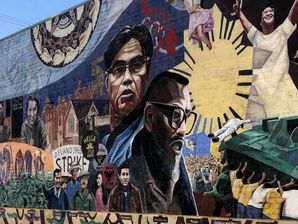
This is a 150' x 30' mural to commemorate important people and events that impacted Filipino Americans. Some of the paintings encapsulate the migration of Filipinos to America and Filipino workers.

The largest Filipino American mural in the United States. Translated in English as "Filipino Americans: A Glorious History, A Golden Legacy," 22-year-old Eliseo Art Silva painted the mural that now overlooks Beverly Boulevard's Unidad Park, unveiling it on 24 June 1995. According to Silva, "... the mural encapsulates 5,000 years of Filipino and Filipino American history."