
Memorials

Herman Jaeger, a Swiss immigrant, settled six miles east of Neosho in 1865 and started a vineyard. He located superior wild grapes in the area. Some of these local disease resistant varieties he sent to France in the 1870’s. They were used to replenish the French vineyards which had been infected by a grape louse. In 1889 he was awarded the French Legion of Honor.
——————
This Pathway Honors Some of Neosho’s Most Outstanding Citizens
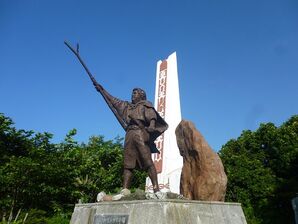
Located at Mauta Park in Hokkaido, Japan
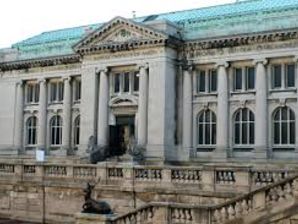
The Hispanic Society of America is a public library and museum in New York City that showcases the arts, literature, and history of Latin American countries.

From early Dutch times the tip of Manhattan was fortified with the batteries of guns from which the Battery takes its name – first at the 17th-century Fort Amsterdam on the Custom House site, then at Castle Clinton. Fort Amsterdam disappeared long ago, but its rubble survives in the layers of landfill that eventually helped create 23 acres of Battery Park, in the process filling in the water separating Castle Clinton from the mainland. Today, The Battery Conservancy is implementing its award-... Read More

Early Presence
Jean Nicolet was among the first Europeans to arrive in
Wisconsin, landing on the eastern shore of Green Bay near Red Banks in 1634. He was followed by Claude Allouez in 1639 and Father Louis Hennepin in 1675.
For the next 200 years, American Indian groups including the Ho-Chunk, Menominee, and Potawatomi shared the regions resources with Euroamerican explorers and settlers.
Early Settlers
Door County’s first community was settled by Increase and Mary Ann Claflin in 1835.... Read More
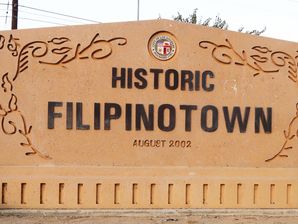
Historic Filipinotown, "Hi Fi," is an ethnic enclave in Los Angeles' 13th district made from the communities of Silver Lake and Echo Park. Previously known as Little Manila, Hi Fi was proposed by council member Eric Garcetti on 02 August 2002, currently serves to preserve the neighborhood's history, and promotes cultural and social unity not just among a Filipino population but one that reflect's LA growing diversity.

In 1829, citizens of the Green Bay area petitioned Congress to build a road to Chicago. Following an ancient Indian trail, the military road to connect Fort Howard at Green Bay with Fort Dearborn at Chicago was surveyed by the U.S. War Department in 1835. Construction began in 1838, but after completion the road was little used by the military and soon became known as the Green Bay Road. This is the north end of the 200 mile historic road that many immigrant settlers used to reach their new... Read More

English: Derived from the Mi’kmaq name, ‘Abadak’, meaning “place with island near”, Baddeck’s first European settler was British officier James Duffus in 1819. He made his home on the “island near” and it was known as Duffus Island. An enterprising man, Duffus operated a general store here, servicing the Scottish immigrants and Loyalist in the area until his death twenty years later. When Duffus’s widow married William Kidston he assumed title to her property including the island and it was... Read More

The Celtic influence permeated the British Islands several centuries before Christ, affecting the languages and culture of modern-day Ireland, Scotland, Wales, and England. The Roman invasions of Britain resulted in the culture in southern Britain (England and Wales) being heavily influenced by the Roman culture of the conquerors.
In northern Britain, however, the natives remained strong and independent. The Romans found these lands and these people too distant, too desolate, and possibly too... Read More
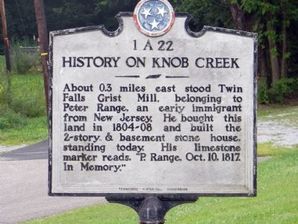
About 0.3 miles east stood Twin Falls Grist Mill, belonging to Peter Range, an early immigrant from New Jersey. He bought this land in 1804-08 and built the 2-story & basement stone house, standing today. His limestone marker reads, “P. Range, Oct. 10, 1817, In Memory.”