
Memorials
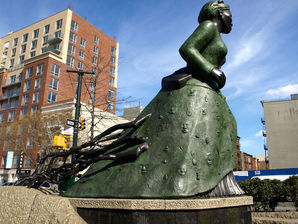
The Harriet Tubman Memorial immortalizes the legacy of the Underground Railroad heroine. The statue of Tubman is also referred to as "Swing Low" which pays homage to "Swing Low, Sweet Chariot," a black spiritual popularized during this period.

Harvard University's Memorial Hall honors Harvard graduates who fought for the Union during the Civil War and represents the alumnus' heroism along with the school's needs for a large gathering space and theater.
Oliver Wendell Holmes composed the following hymn for the laying of Memorial Hall's cornerstone in 1870:
"Not with the anguish of hearts that are breaking
Come we as mourners to weep for our dead;
Grief in our breasts has grown weary with aching,
Green is the turf where our tears... Read More
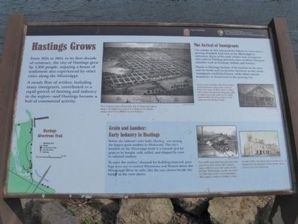
From 1856 to 1865, in its first decade of existence, the city of Hastings grew by 2,500 people, enjoying a boom of settlement also experienced by other cities along the Mississippi.
A steady flow of settlers, including many immigrants, contributed to a rapid growth of farming and industry in the region — and Hastings became a hub of commercial activity.
The Arrival of Immigrants
The treaties of 1851 relocated the Dakota to reservations, opening abundant land west of the Mississippi to... Read More

In May 1859, Olof Olson Haugen, his wife Bergeret, and son Frederick homesteaded here in section 32, Dovre Township. Over the next three years, the Haugen family diligently worked to establish their new life; building shelter, raising crops and animals, and developing relationships with people who came before them.
Dakota people had hunting and fishing camps in Kandiyohi County before the American and European immigrants came. These immigrants had to learn how to co-exist with the Dakota. Many... Read More

You wouldn't know it now, but this part of Milwaukee was one of the city's most populated neighborhoods in the late 1800s and early 1900s. A vast public market here drew people from all over town. Although the haymarket has faded away, its legacy remains as the cityscape continues to evolve.
An Early Settlement in Old Milwaukee
The Haymarket neighborhood mainly covers the blocks between Juneau Avenue on the south, Walnut Street on the north, 3rd Street on the east and 8th Street on... Read More

This plaque is dedicated to
HIAS, The Hebrew Immigrant Aid Society
which occupied this building from
1921 to 1965.
As the international migration agency of the American Jewish community, HIAS' work, providing rescue and refuge for endangered and persecuted people of all faiths and backgrounds around the world, continues to this day.
Founded in 1881, HIAS has rescued more than 4,500,000 men, women, and children, including members of almost every Jewish family in America. Tens of... Read More

These premises housed the Hebrew Technical Institute Founded in 1884. A non-sectarian school. One of the first technical high schools in the United States. Last graduating class 1939. The school was conceived at a meeting of the United Hebrew Charities, the Hebrew Orphan Asylum and the Hebrew Free School Association for the purpose of training youths of immigrants in industrial arts.

Henry Kolwey, an immigrant from the Duchy of Hanover (present day Germany), established a home on this site in 1857. According to the 1860 census, Kolwey, a master shoemaker, lived and worked here with his wife Anna, their four children, and four apprentice shoemakers.

This park was once the summer home of "the cattle king" Henry Miller. Mr. Miller was the dominant partner in the firm Miller & Lux. The large foundation on your left was Mrs. Miller's home, and the other two foundations were a dining hall and possibly their son's house. Arriving in America as a penniless immigrant, Henry Miller died on October 14, 1916, owning over 1,000,000 acres of land and 1,000,000 head of cattle.
Originally Dedicated July 26, 1975
Rededicated... Read More

In this vicinity Henry Shelton Sanford, pioneer citrus grower, established the St. Gertrude grove in 1871. There, and at his Belair grove and experimental gardens, he advanced the industry through development of some 140 types of citrus. The Sanford gardens experimented with other tropical fruits, planting 30,000 exotic trees from South America and Africa. Much of the labor in the groves was performed by Swedish immigrants who settled at nearby New Upsala.