
Memorials

Dedicated in 1997, the Hmong and Lao Memorial pays homage to the Hmong and Laos veterans who fought alongside the United States during the Vietnam War. Indigenous Hmong peoples who lived in the mountains of Vietnam and Laos, along with many Laos, aided the United States in the CIA's "Secret War". The memorial was approved by the U.S. Department of Defense and the U.S. Army, and marked the first time the U.S. government officially recognized the contributions and sacrifices of the Hmong and Laos... Read More

English, Irish and German settlers, as well as enslaved and free African Americans, were the first non-natives to claim Brightwood. Farmers dominated until the Civil War. Then in the 1890s electric streetcars allowed government workers to live here and ride to jobs downtown. By the 1940s, sons and daughters of Jewish, Greek, and Italian immigrants had arrived, often leaving crowded conditions in older neighborhoods.
Abraham Posin, founder of Posin's Deli and Bakery, was typical of the... Read More
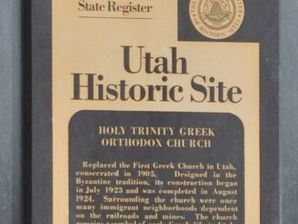
Replaced the First Greek Church in Utah, consecrated in 1905. Designed in the Byzantine tradition, its construction began in July 1923 and was completed in August 1924. Surrounding the church were once many immigrant neighborhoods dependent on the railroads and mines. The church remains a symbol of early Greek life in Utah.

Constructed in the traditional Byzantine style, Holy Trinity held its first service on August 15, 1924. Located in the center of the Salt Lake City immigrant district, the church served Greek miners, railroad and smelter workers and their families. Architects for the building were the local firm of Pope and Burton working with a Greek architect from Chicago, N.A. Dokas.

The Holy Trinity Greek Orthodox Church is evidence of the size and religious devotion of Salt Lake City's Greek immigrant community. In the early 20th century, Greeks were the largest immigrant group in Utah. Salt Lake City's Greek community was centered in a "Greek Town" with over 60 Greek businesses located on 200 South between 400 and 600 West. Completed in 1924, the Holy Trinity Greek Orthodox Church is an excellent example of Byzantine Revival style architecture. A... Read More

In 1979, local restaurant owner "Trader" Vic Bergeron donated this monument in recognition of the contributions of Chinese immigrants to America. Originally located at the site of the former Asiatic Dining Hall, it was relocated to this overlook in 2006 during the Immigration Station renovation.
1979年,一位當地經營餐館的業主魏克.
波格龍揭款建這個紀念碑,紀念華人移民
為美國做出的貢獻。原來立於前「亞州傻
餐廳」,後在2006年重建移民鶴留所遺址
時移至此可俯嫩大海的地方。

The "Flying Dutchman" was hailed as baseball's greatest shortstop and one of its finest all-around players. A lifelong Carnegie resident, born to German immigrants. Played for Louisville Colonels, 1897-1899, and the Pittsburgh Pirates from 1900-1917; a Pirates coach from 1933-1951. He set many National League records, including one for eight seasonal batting titles. Known for his modesty and sportsmanship. Charter member, Baseball Hall of Fame, 1936.

An ornamental eagle perched high in front of
the Eagle Hotel one block south. Irish
immigrant James Patton opened the hostelry in
1814. Almost opposite the Eagle, the
Swannanoa Hotel began operation in 1878,
making South Main Street - now Biltmore
Avenue - a nineteenth-century social center.