
Memorials
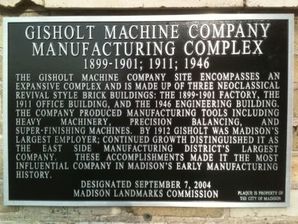
The Gisholt Machine Company site encompasses an expansive complex and is made up of three Neoclassical Revival style brick buildings: The 1899-1901 factory, the 1911 office building, and the 1946 engineering building. The company produced manufacturing tools including heavy machinery, precision balancing, and super-finishing machines. By 1912 Gisholt was Madison's largest employer; continued growth distinguished it as the east side manufacturing district's largest company. These... Read More

Stone 1:
St. Aubin Park Riverwalk
Glimpses of Detroit's Riverfront History
This walk made possible by:
Friends of Partners
Detroit Recreation Department
Dedicated July 1969
Stone 2:
The Many Names of Detroit
1880: City of the Straits (Major Great Lakes Port)
1920: Motor City (Automotive Capital of the World)
1963: Motown (Center of American Popular Music)
1980: The Renaissance City (Gateway to 21st Century)
Stone 3:
The Shipyard
Starting in 1852, this site was a busy shipyard. The... Read More

(Side One)
Erected in 1862, this church was the center of the Dutch immigrant community. The first settlers in this area arrived in early 1847 led by the Reverend Albertus C. V. Raalte. In June of that year a separate group of seventy people from Graafschap Betheim, near the Dutch border, founded this village which they named Graafschap. Joined by thirty-four other immigrants from Drente, the Netherlands, the villagers shared common religious views and spoke similar dialects. Before erecting a... Read More

Built at the turn of the century as a retirement home for Leon Graugnard, a French immigrant from Basses-Alpes, France. Graugnard, married to Eva Bacas, was a respected and accomplished businessman and was known as one of the most successful sugar planters in Louisiana. The house is the surviving structure of Terre Haute Plantation owned by Graugnard and his heirs. Emile Graugnard, Eva Graugnard Guidry, and Marie P. Graugnard.
English:
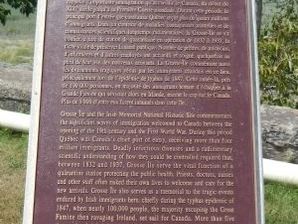
Grosse Île and the Irish Memorial National Historic Site commemorates the significant waves of immigration welcomed to Canada between the opening of the 19th century and the First World War. During this period Québec was Canada's chief port of entry, receiving more than four million immigrants. Deadly infectious diseases and a rudimentary scientific understanding of how they could be controlled required that, between 1832 and 1937, Grosse Île serve the vital function of a... Read More

As early as 1886, German immigrants here observed Groundhog Day and established the Punxsutawney Groundhog Club in 1899. According to folklore, if the hibernating groundhog—known as Punxsutawney Phil—leaves its burrow on February 2 and sees its shadow, there will be six more weeks of winter. The legend is based on a European custom predicting the length of winter by weather conditions on Candlemas, an ancient Christian festival.
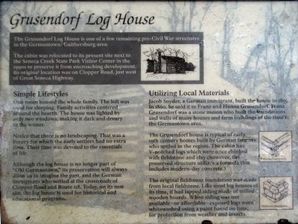
The Grusendorf Log House is one of a few remaining pre-Civil War structures in the Germantown/Gaithersburg area.
The Cabin was relocated to its present site next to the Seneca Creek State Park Visitor Center in the 1990s to preserve it from encroaching development. Its original location was on Clopper Road, just west of Great Seneca Highway.
Simple Lifestyles
One room housed the whole family. The loft was used for sleeping. Family activities centered around the hearth. The house was lighted by... Read More

Named after Frank Gubser, a German immigrant and barber, Gubserville was an important stage, mail and teamster stop on the road between San Jose and Saratoga. Gubser served as the village's first and only postmaster, beginning July 5, 1882. Gubserville ceased to exist officially when the post office was discontinued on April 15, 1897.

On this site in 1882, Gustave H. Grimm (1850-1914), a German immigrant tinsmith, established the G.H. Grimm Manufacturing Company. His device, the Champion Evaporator, revolutionized maple syrup production with the use of a corrugated pan which increased the efficiency of evaporating liquids such as saps. Grimm's business became the world's leading manufacturer of maple supplies. His contributions as an inventor, researcher, and manufacturer established him as a leader in the maple... Read More

Times were tough in the life of an immigrant farmer in northeastern Minnesota. Subsistence farming was a way of life that had gone on for centuries in Finland. Immigrants knew what was needed to survive in the harsh climate of the area. All family members old enough to work - men, women and children - did their share in clearing the land and creating a homestead. Facing thin rocky soil and a short growing season, immigrants in Embarrass planted potatoes, which became the major cash crop of the... Read More