
Memorials
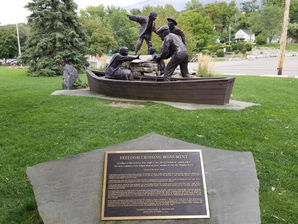
This bronze monument recognizes the fleeing of slaves to Canada. It depicts several slaves escaping America on a boat.

Miami Dade College's Freedom Tower was operated by the U.S. government as a reception center for Cuban refugees from 1962 to 1974. Constructed in 1925 as a home for The Miami News. The MDC Museum of Art + Design, a 15,000 square foot exhibition space on the second floor.

French immigrants settled the area in 1832. A pure strain of the French language was spoken here until the 1960's. Since St. Mary's Catholic Church was built in 1870, it has been the site of the annual Frenchville Picnic. The first white burial in the county (1771) was French seaman Tohas Auxe, who died enroute from Canada to New Orleans. The stone was discovered on a local farm in 1896.

Front Street, once noted for its markets and first local homes of poor immigrants, no longer exists. Laid out in the 1820s as two long blocks, Front Street was lined by low brick buildings.
While the ground floors contained markets, small shops and saloons, the lofts housed successive waves of poor immigrants: Irish, Germans, Jews and, later, Italians. As they became established, they moved to other neighborhoods: Irish to "Dublin," Italians to "Mt. Allegro," Germans to... Read More

Along this avenue, once called Front Street, thousands of immigrants came after leaving their war-ravaged, poverty-stricken countries in search of freedom and a better life. They helped to build the City of Hartford, the roads on which their descendants would one day travel, and the buildings in which they would one day work.
They brought with them a wide range of religious and ethnic backgrounds, and they added their trades and crafts to the city's commerce. They labored within Hartford... Read More
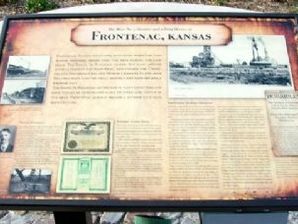
Frontenac, Kansas first came into being when the coal mining industry moved into the area during the late 1800s. The Santa Fe Railroad leased the land around what is present-day Frontenac, and formed the Cherokee and Pittsburg Coal and Mining Company. In 1886, mine No. 1 was sunk and a small mining camp soon became a booming city.
The Santa Fe Railroad advertised in many countries and soon flocks of immigrants came to work and settle in the area. Frontenac quickly became a diverse city, rich... Read More
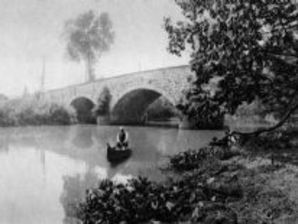
This bridge was constructed by Irish immigrants. This is where the saying “paying off the dead horse,” came out. This is because they worked on the bridge to pay off the cost it took to immigrate from their home country to America. Working conditions were rough and locals would provoke and taunt the immigrants. The bridge was finished in 1823, but since then had some work done to it. In 1931 the bridge was widened.

Galveston was the port of entry for thousands of immigrants who settled in Texas and the southwest. Federal laws enacted in 1875 ended the unrestricted entry of immigrants into the country and led to the establishment of the area's first U.S. Immigration Station at Galveston's Pier 29. There U.S. Customs officials conducted medical exams, baggage inspections and formal processing of immigrants; those found to be diseased or incapacitated faced deportation. The U.S. Congress chose... Read More
Several routes of the Underground Railroad went through Michigan. This statue commemorates the route through Detroit. Another favorite crossing point was south of Detroit near where Amherstburg, Ontario is located. This is, perhaps, the narrowest Point in the Detroit River. And by the mid-1830s, there was a modest population of former slaves living there who aided other to escape to freedom
Several routes of the Underground Railroad went through Michigan. This statue commemorates the route through Detroit. Another favorite crossing point was south of Detroit near where Amherstburg, Ontario is located. This is, perhaps, the narrowest Point in the Detroit River. And by the mid-1830s, there was a modest population of former slaves living there who aided other to escape to freedom.