
Memorials

Emily Torstensenseim immigrated to the United States from Norway with her parents at the age of four. When she grew up she married a fellow Norwegian immigrant, Ole Thompson, who became a successful hotelier and grocer. Shortly after his death, his widow built this cream brick house for herself and her four children. It is a surviving and distinguished example of the smaller houses built in the first decades of Madison's history, many of which have been lost to the "march of progress... Read More
This grave is dedicated to poet and patriot, Emma Lazarus who wrote the New Colossus. She was very active and well known in the Jewish community.

The small scale and low rents of H Street's oldest buildings have lured waves of immigrant entrepreneurs since the buildings were new in the 1880s. By 1930, alongside Greek, Italian, Irish, and other immigrant-owned shops, at least 75 Jewish-owned businesses operated on H Street. Abe and Anna Shulman ran a dry goods store and lived at 1237 H, with a kitchen in back and living quarters upstairs. Two of their five children remained on H Street as adults: Israel, a dentist, and Fred, who... Read More
The structure is a cement shaft curved at the top in the shape of a petal or a leaf. Inside the petal/leaf shape are pieces of wood in the shape of flames. Sandstone walkways surround the structure, representing the Baltic Sea, which played a significant role in the Estonian people's immigration to America. Estonian flags extend from either side of the structure. Inscribed on the monument are the words, "But the time will come when all torches will burst into flame at both ends." This is an... Read More

The Estonian community unveiled a symbolic flame in the Estonian garden as a dedication to the national identity of Estonia. The poem inscribed in the flame comes from Kalevipoeg, an epic that sparked the creation of the Estonian Identity.
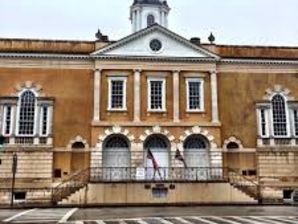
The Exchange and Provost building, also known as the Old Exchange building, served as a center for trade and commerce in Charleston, South Carolina. In particular, the area in front of this building was the main location for slave trading in the area.