
Memorials

Many Danbury land records were destroyed during the British raid of 1777. Historic newspapers, old deeds and early maps help us piece together some of the earliest place names of our city.
Parts of Danbury were lost to Bethel when it broke away in 1855 including Pinchgut, Wolfpits, and Puppytown. Other colorful names have simply disappeared over time such as Mashing Tub Swamp and Stubble-lot Road.
The Borough of Danbury began to officially name its streets in 1846 and by 1878 Towne Street had... Read More

During the first hundred years of Scottish immigration to the Americas, Philadelphia was the largest city in the British colonies, and the second largest city in the British empire. As such, its booming port was a natural destination for emigrant Scots. Many of those arriving in Philadelphia were poor or sick and in need of money, work, and friends. In 1747, a group of Scots immigrants who were already established in Philadelphia founded the St. Andrew's Society of Philadelphia to assist... Read More

Revolutionary War veteran John Crawford and his wife, Ann, founded this cemetery in 1837. Ornate headstones exhibit trends in funerary art over two centuries, and the German script on markers reflects the migration of European immigrants after the Erie Canal opened in 1825. Veterans of every major war since the American Revolution are buried here. The community was named Meade in 1863, but remained locally known as the Crawford Settlement.
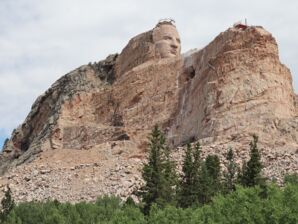
The Crazy Horse Memorial memorializes the Lakota warrior Crazy Horse. The carved memorial in the South Dakota Black Hills was originally commissioned by a Lakota elder, Henry Standing Bear in the in June 1948. Henry Standing Bear commissioned Korczack Ziolkowski, an important player in the Mt. Rushmore Presidents, to sculpt The Crazy Horse Memorial. Though Ziolkowski died in 1982, his wife Ruth took over the project and the memorial is still being sculpted today.

(Marker 1, Native Americans)
During the course of Chillicothe’s history many diverse groups have come to inhabit the area with the earliest being the Native American as early as the late 1600's. During the American Revolution, the Shawnees fought alongside the British. Shawnees believed that England would prevent the colonies from invading their land even more. Under one of their most famous leaders, Tecumseh, the Shawnee were fierce warriors. When the Shawnees divided themselves into many... Read More
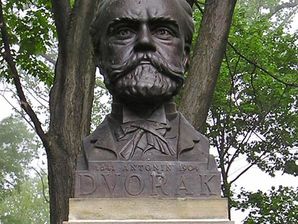
This is a garden dedicated in 1935, memorializing Czech parents who exemplified "high ideals of American citizenship" and migrants from Bohemia and Moravia to the United States. The garden has a circular layout and has the most statues of all the gardens in the Cleveland Cultural Gardens.
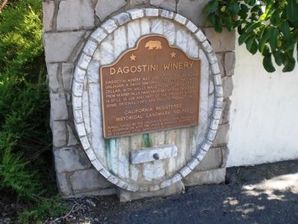
D’Agostini Winery was started in 1856 by Adam Uhlinger, a Swiss immigrant. The original wine cellar, with walls made from rock quarried from nearby hills, hand hewn beams, and oak casks, is still in use and part of the present winery. Some original vines are still in production.

Built in 1796 by
Daniel Ravenel,
the Second of
Wantoot Plantation,
as a summer home
replacing an earlier building
destroyed in the great fires of that year.
The property came to
his wife in 1749,
having been owned since 1710
by her grandfather
Isaac Mazyck,
the French
Huguenot Immigrant.
This land, with 10 generations of occupancy,
is one of the oldest properties
in this city, and perhaps
the nation, to remain continuously
in the same family.

Darlingside is a rare surviving example of the wood depots which provided an essential fuelling service during the early phase of steamboat navigation on Lake Ontario and the upper St. Lawrence River. Thomas Darling, a Scottish immigrant, acquired the wood depot in the late 1830s and added a general store in 1845, both of which operated until the late 19th century. Steamers supplied goods for the store and took on cordwood for fuel and other products for export. Prior to the railways, depots... Read More

Built by Finnish immigrant and homesteader, Jacob (Tapola) Davidson, it served Old-Brule and Lakeside in the South Shore region from 1904 to 1926. Constructed of native materials, it was used for milling locally grown grains for both animal and human consumption.