
Memorials

Our Lady of Christians started as a shrine in 1851. Fulfilling a vow he made during an Atlantic storm in November 1836. German immigrant Joseph Batt gave land and built the shrine. In October 1890, this church became the first parish in Cheektowaga.

In 1847 Reverend Pieter Zonne led a group of Netherlanders, originally from the Gelderland Province, to this area where a few other Dutch immigrant families had recently settled. Enticed by Zonne's energetic advertisements that "there is plenty of everything and we have sold more than $1,000 worth of fattened cattle," many additional Dutch immigrants came to the "Zonne Settlement," later named Cedar Grove. Within five years, the settlers had systematically cleared vast... Read More

Swedish immigrant Sven Anderson built this early settler's cabin in 1852; some of the cabin logs still show the marks from the axe, which squared them. Sven and his wife Stava raised three children in this cabin, and it was their home until 1869. Their first son, Charles, was born May 12, 1858 – one day after Minnesota became a state. Sven Anderson is credited with bringing the first cattle to this area, as well as being one of the first wheat farmers.
For the 1938 Marine centennial... Read More

"The enemy stood with a tenacity never before displayed by them, but with bayonet, clubbed musket, sword and pistol, and rocks from the wall, we cleared the heights and silenced the guns." Maj. Samuel McD. Tate, C.S.A. 6th North Carolina Infantry About dusk on July 2, two Confederate infantry brigades of Early's Division appeared in line of battle on the rolling pastures below you to the right. Their objective was East Cemetery Hill, 1/4 mile in front of you. Union cannon here... Read More

Founded in 1854 as Fillmore, it was renamed for noted mining engineer Eckley Coxe. It was built to house anthracite coal miners and their families, many European immigrants. Coal patch towns like Eckley were common in northeast Pa. in the late 1800s and early 1900s. Colliery operations declined by the 1950s, but the site was restored for the 1970 film The Molly Maguires. Subsequently it was converted to a state historic site operated by PHMC.
_54750.jpg?itok=d-25gu8B "Effigy_Mounds_National_Monument_Sign_Iowa_(24649687506).jpg")
Established in 1949, Effigy Mounds National Monument preserves many American Indian ceremonial mounds found in the shape of animal effigies along the high bluffs and lowlands of the Upper Mississippi River Valley. The 2,526 acre Monument preserves more than 200 mounds, including 31 in the form of bear and bird effigies. The hunter-gatherer culture that built these mounds were known as the Woodland Indians. Archeologists and researchers hypothesize that some of the mounds were built for... Read More

El Monte, on the bank of the San Gabriel River, played a significant part in California's early pioneer history. It was first an encampment on the Old Spanish Trail, and extension of the trail from Missouri to Sante Fe. By the 1850's some began to call El Monte the "End of the Santa Fe Trail." Early in that decade a permanent settlement was esablished here by immigrants from Texas. The first settlement in Southern California founded by citizens of the United States.
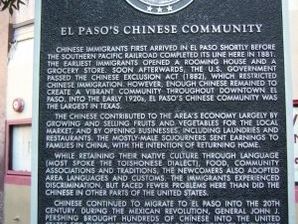
Chinese immigrants first arrived in El Paso shortly before the Southern Pacific Railroad completed its line here in 1881. The earliest immigrants opened a rooming house and a grocery store. Soon afterwards, the U.S. Government passed the Chinese exclusion act (1882) which restricted Chinese immigration. However, enough Chinese remained to create a vibrant community throughout downtown El Paso. Into the early 1920s, El Paso's Chinese community was the largest in Texas.
The Chinese... Read More

The first Elite cafe opened in downtown Waco in 1919 and was acquired by the Greek immigrant Colias family in 1920. The Colias brothers opened this Elite cafe in 1941 on "The Circle," a traffic hub built on Waco's suburban edge in the early 1930s. A highly recognized local landmark, and one of the best remaining regional examples of mid-20th century roadside architecture, the building exhibits a distinctive Spanish Colonial style popular in the southwest.
Recorded Texas Historic... Read More

An immigrant from Denmark where he had studied forestry, he came to this part of Idaho in 1883 to mine, hunt and trap.
Before Idaho became a state in 1890, he built a winter cabin below Grandjean Peak on a site later occupied by Grandjean Ranger Station. Because of his European studies, he became a professional forester here. Then he served as supervisor of Boise National Forest from 1906 to 1922.