
Memorials

The stones you see here reveal yet another layer of the story of Ellis Island. This is the story of Fort Gibson, one of the earliest forts built after the American Revolution to protect New York Harbor. Discovered during the excavations for the American Immigrant Wall of Honor, these remains of the walls of Fort Gibson bear witness to the nearly 100 years when Ellis Island was used to ward off enemies rather than to welcome immigrants. Two forts stood on the site. The first was a crescent-... Read More
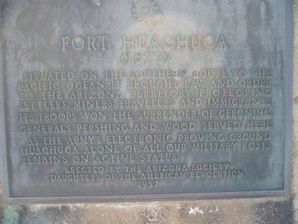
Situated on the southern route to the Pacific Ocean, it brought law and order to the Arizona Territory, protecting settlers, miners, travelers and immigrants. Its troops won the surrender of Geronimo. Generals Pershing and Wood served here.
As the Army's electronic proving ground Huachuca alone of all our military posts remains on active status.
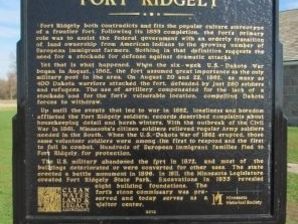
Fort Ridgely both contradicts and fits the popular culture stereotype of a frontier fort. Following its 1855 completion, the Fort’s primary role was to assist the federal government with an orderly transition of land ownership from American Indians to the growing number of European immigrant farmers. Nothing in that definition suggests the need for a stockade for defense against dramatic attacks.
Yet that is what happened. When the six-week U.S.-Dakota War began in August, 1862, the fort... Read More

The establishment of Fort Ripley in 1848 represents the U.S. government’s effort to establish control on the northern frontier. Construction began on the west bank of the Mississippi River across from this point a year before Minnesota became a territory. The government intended it to be a buffer between lands of the Dakota and the Ojibwe and to protect the Ho-Chunk (Winnebago) who had been unwillingly moved from their land in Wisconsin Territory as part of the buffer.
Originally known as... Read More

Side A:
Frances Rappaport Horwich was born in Ottawa on July 16, 1907, the daughter of Sam Rappaport, an Austrian immigrant who operated a general store, and Rosa Gratz Rappaport, a Russian immigrant. The youngest of six children, she attended the Ottawa elementary school and graduated from Ottawa High School in 1924. After high school, she attended the University of Chicago where she earned a bachelor's degree in philosophy and then taught first grade for three years. "Miss Frances,... Read More

Pittsburgh sculptor whose subjects included American presidents and public figures such as Abraham Lincoln, Honus Wagner, and Mark Twain. He devoted his life to sculpting and teaching, and founded the city’s Society of Sculptors. An Italian immigrant, Vittor sculpted Christopher Columbus here, one of his best-known works. He created it with the support of the Sons of Columbus of America and in honor of his Italian heritage.

Site of headquarters for Franklin & Armfield, one of the country's largest slave-trading firms in early 1800s. Yard behind headquarters building housed imprisoned slaves before they were sent to market. Company primarily involved in interstate slave trade (buying slaves in Virginia area to be sold in New Orleans or elsewhere in Deep South).
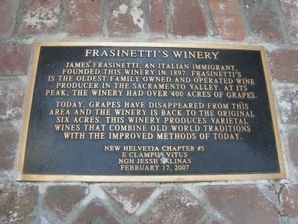
James Frasinetti, an Italian immigrant, founded this winery in 1897. Frasinetti’s is the oldest family owned and operated wine producer in the Sacramento Valley. At its peak, the winery had over 400 acres of grapes.
Today, grapes have disappeared from this area and the winery is back to the original six acres. This winery produces varietal wines that combine old world traditions with the improved methods of today.
New Helvetia Chapter #5
E Clampus Vitus
NGH Jesse Salinas
February 17, 2007