
Memorials

Northeast Mississippi's upholstered furniture industry began here in 1948. Founded by Morris Furtorian, a Russian immigrant from Chicago, the Stratford Company utilized assembly line methods developed by the automotive industry, an innovation that revolutionized the furniture business and transformed the area's economy.

In 1884 William Schickel designed this building as a health clinic for the city's German immigrants. It is an ornate version of Italian Renaissance design. the facade is enhanced by sculpted portrait busts of famous physicians and scientists, including English physiologist, William Harvey; Swedish botanist, Carolus Linnaeus; French chemist, Antoine LaVoisier; and German naturalist, Friedrich von Humboldt.

The Suhr Bank Building is an elegant example of the Italianate style applied to a commercial building. Designed by influential Madison architect John Nader, the building is of regularly coarse sandstone with a projecting cornice featuring pairs of scrolled brackets. The windows are ornamented with sandstone hoods and the main entrance has composite columns and a classical entablature. The building is also significant for its association with John Suhr, a German immigrant who established one of... Read More
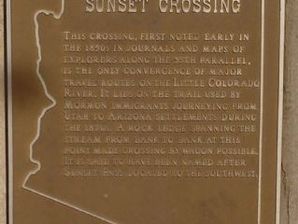
This crossing, first noted early in the 1850s in journals and maps of explorers along the 35th parallel, is the only convergence of major travel routes on the Little Colorado River. It lies on the trail used by Mormon immigrants journeying from Utah to Arizona settlements during the 1870's. A rock ledge spanning the stream from bank to bank at this point made crossing by wagon possible. It is said to have been named after Sunset Pass located to the southwest.
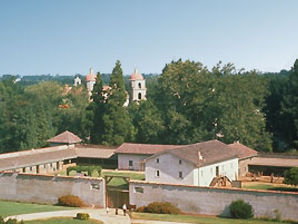
This marks the site of Sutter's Fort, one of the first major trading posts in post-Spanish, pre-United States California. Though the original fort collapsed, a replica was rebuilt and became a California State Park.

This is the western edge of what once was the rough, working-class Swampoodle neighborhood. In the early days the marshy Tiber Creek ran between what are now North Capitol and First Streets, NE. Legend has it that lingering rain puddles ("poodles") led to the neighborhood's nickname. Swampoodle's earliest residents, mostly Irish immigrants and free African Americans, helped build this city. Their hands crafted the White House and the Capitol, among other buildings.... Read More

A native of Basthult, Barkeryd Parish, in the province of Smaland, Sweden, Swante Palm was a leader of early Swedish immigration to Texas. Influenced by his nephew, Swen Magnus Swenson, Palm came to Texas in 1844. He settled first in La Grange, where he served as postmaster and worked in Swenson’s general store. Both men moved to Austin in 1850 and continued their business relationship. In 1854 Palm married Agnes Christine Alm. Their son, Swante Sture, was born in 1855, but died in infancy.... Read More

Swedish immigration to Texas began with the arrival of Swen Magnus Swenson in 1838. Settling first on the Gulf Coast, he became a successful businessman. In 1850 he moved to Austin, where he established a ranch in the area he later named Govalle ("Good Grazing Land"). His uncle, Svante Palm, joined him in Austin in 1850 and together they promoted Swedish immigration to Texas. By 1910 some 7,000 Swedes came to Texas and established homes, farms, businesses, and churches. Palm became a... Read More

Sweet Home Common School #15 was originally located on the east side of Sweet Home Road, south of Tonawanda Creek Road, 1/4 mile from the Erie Barge Canal. German-speaking families, who had emigrated from the Alsace-Lorraine region on the border of Germany and France, populated this area of northwest Amherst known as the "French Settlement." These settlers traveled the Erie Canal to their new homes in rural Amherst, where farmland was plentiful. The Sweet Home School was built in... Read More