
Memorials

A cigar factory built on this site in June 1892 by Hugh C. Macfarlane brought the first industry to the community of West Tampa. First operated by A. Del Pino and Company, it failed financially. In 1894 the O'Halloran Cigar Company occupied the building. On May 18, 1895, a bill passed Florida's legislature creating the municipality of West Tampa. Its first mayor was Fernando Figueredo, a prominent figure in the Cuban revolution. Sponsored by the Tampa Historical Society - June 15,... Read More
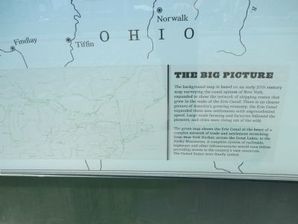
The background map is based on an early 20th century map surveying the canal system of New York, expanded to show the network of shipping routes that grew in the wake of the Erie Canal. There is no clearer picture of America's growing economy: the Erie Canal expanded these new settlements with unprecedented speed. Large-scale farming and factories followed the pioneers, and cities were rising out of the wild. The green map shows the Erie Canal at the heart of a complex network of trade... Read More

35 Calhoun Street, was constructed in 1852
by Irish immigrants and purchased in 1939 by Willis
Johnson, Sr., who was born a free man at Drayton
Hall Plantation, West Ashley. 35 Calhoun Street and
35-1/2 are two-story wood framed Charleston single
houses with red tin roofs containing 6 rooms and
2 bathrooms with side porches on each level.
35-1/2 Calhoun Street was built in 1940 by two of
Willis Johnson's sons, Frank and Henry as a test
for the completion of their carpentry apprenticeship... Read More
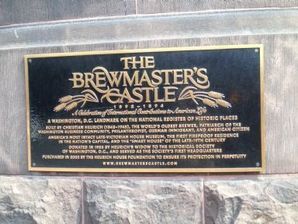
A Washington, D.C. Landmark on the National Register of Historic Places
Built by Christian Heurich (1842-1945), the world's oldest brewer, patriarch of the Washington business community, philanthropist, German immigrant, and American citizen
America's most intact late-Victorian house museum, the first fireproof residence in the nation's capital, and the "smart house" of the late-19th Century
Donated in 1955 by Heurich's widow to the Historical Society of Washington... Read More

From its founding, Castroville has been home to immigrants. They came from many countries to make better lives for themselves and their children. Then, as now, the immigrants primarily worked in the fields nearby.
Japanese immigrants wanted their children to value the traditions of their home country. In 1935 they built this school as a place to teach Japanese-American youth to appreciate the rich customs and heritage of the Japanese culture.
Recent immigrants share the hope that their children... Read More

English:
Raised in 1909 by members of the Ancient Order of Hibernians, this monument honours the memory of the thousands of Irish immigrants who died on Grosse Île in 1847. Inscriptions in Irish, French and English recall their tragic destiny during the Great Famine.
French:
Érigé en 1909 par des membres de l’Ancient Order of Hibernians, ce monument honore la mémoire des milliers d’immigrants irlandais décédés à la Grosse-Île en 1847. Des inscriptions en gaélique, en français et en anglais... Read More
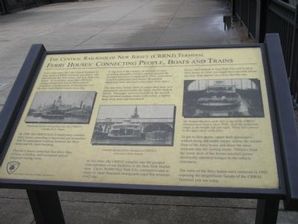
From 1864 until 1967: the Central Railroad of New Jersey (CRRNJ) Terminal provided a vital link between the New Jersey and New York City shores. At its busiest, more than 200 ferry sailings transported tens of thousands of commuters and thousands of immigrants over the New York Harbor waters every day. In 1889, the CRRNJ built a single-story wooden ferry house, providing a functional and protective link for passengers walking between the ferry boats and the main building. This ferry house... Read More

After passing the Statue of Liberty and being processed at Ellis Island, where did the new Americans go? Once declared “clearly and beyond a doubt, entitled to land” almost two-thirds of the immigrants processed at Ellis Island bought train tickets from the Central Railroad of New Jersey (CRRNJ) ticket office on the island. They then boarded ferries which brought them here to the CRRNJ Terminal in Jersey City. Upon arrival at the CRRNJ Terminal, the immigrants awaited their trains in the... Read More

These stone walls are part of a network of trails and roads built by Chinese immigrants. In 1872 Simon L. Jones bought 1,500 acres of timberland in Woodside and developed them into farmlands, orchards and vineyards with the use of Chinese labor. These fine, enduring walls, constructed without mortar or coping, are a testament to the craftsmanship and expertise of Chinese workers, whose labors helped to build California.
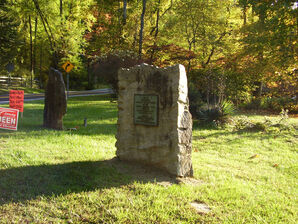
Dedicated to a lost settlement of the Cherokee tribe. The former Conestee town, or also referred to as Kana’sta, was believed to have been abandoned between the 1750-1770's. Cherokee legend says these people were invited to a secret, flourishing village located within the mountains and they alone of all the Cherokee Nation escaped the long wars and suffering that followed the settlers' invasion of the mountains.