
Memorials
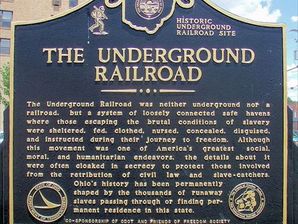
Many runaway slaves escaped from Kentucky to Portsmouth, Ohio. They crossed the Ohio River and it was very dangerous due to it being very close to Pro-Slave state.

“The Docks” has had a remarkably varied occupational history. Gold Rush immigrants camped along the riverbank. In the following years, a limited number of individuals and families lived in the area in private residences and lodging houses. From the beginning of Euro-American occupation, however, the area was dominated by commercial and industrial activity because of its location adjacent to a navigational river. Speculators; small businesses including saloons, fish wholesalers, bakeries and... Read More
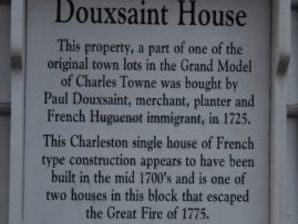
This property, a part of one of the
original town lots in the Grand Model
of Charles Towne was bought by
Paul Douxsaint, merchant, planter, and
French Huguenot immigrant, in 1725.
The Charleston single house of French
type construction appears to have been
built in the mid 1700’s and is one of
two houses in this block that escaped
the Great Fire of 1775.
The present interior details reflect both
late Georgian and early Federal periods.

Constructed in 1907, Henry Schwarz and Frank Greulich named the building The Empire Block for their business, the Empire Meat Market. At the dissolution of the Schwarz and Greulich partnership in 1916, the building was purchased by Frank Greulich and was maintained by his heirs for many years. The five ground floor store fronts were occupid by many different retail businesses. On the second floor, the Empire Rooming House, later named Spur Hotel, was of questionable reputation, the proprietress... Read More

This 1894 saloon and hotel belonged to the Van Detto family, recently arrived Italian immigrants. Located a few hundred feet east of Lock 52, the Erie House was a popular destination for the canal community.
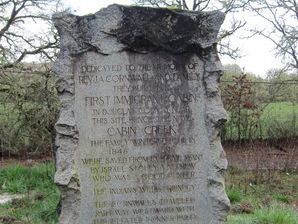
Dedicated to the memory of
Rev. J.A. Cornwall and Family
They built the
First Immigrant Cabin
in Douglas County near
this site hence the name
Cabin Creek
The family wintered here in
1846 1847
Were saved from extreme want
by Israel Stoley, a nephew
who was a good hunter
The Indians were friendly
The Cornwalls traveled
part way westward with
the illfated Donner Party

Harris Franklin, his wife Anna, and son Nathan arrived in Deadwood, Dakota Territory in 1877. A Jewish immigrant from humble beginnings, Harris Franklin earned his fortune through the wholesale liquor business and gradually diversified into cattle, gold mining, and banking.
Between 1883 and 1890, the Franklins purchased four parcels of land in order to build their lovely home with all the modern amenities. In 1891 Harris and Anna Franklin commissioned Simeon D. Eisendrath, a Jewish architect... Read More

By the late 1800's, thousands of Jews began fleeing their homes in Russia and Eastern Europe to escape anti-Semitic policies and violent pogroms. Many immigrated to the U.S., establishing communities in New York City and elsewhere along the East coast. Overcrowding in these neighborhoods coincided with growing anti-Semitic sentiment. The Galveston Movement, a humanitarian effort that brought nearly 10,000 Jewish immigrants through the Port of Galveston between 1907 and 1914, was initiated... Read More
_0b0f7.jpg?itok=r9m1npBU "Garden of Remembrance")
The Garden of Remembrance is a half-acre memorial garden in downtown Seattle to honor the Washington State residents who died in wars since World War II.
"The Gateway Arch"/"The Gateway to the West" is the US's largest monument. Constructed in 1965, the memorial is commemorating western expansion and the beginning of manifest destiny in the US. Created by Eero Saarinen, "The Gateway" is featured in St. Louis, MO as that is said to be the beginning of western half of the US.