
Memorials
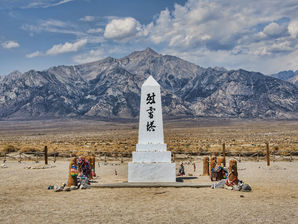
This tower in Manzanar was created by Ryozo Kado in 1943 to memorialize the over 100,000 Japanese migrants detained in the Manzanar internment camp during World War II.

One of several curb markets established in the early 20th century to counter high prices and food shortages despite anti-immigrant sentiments and criticisms regarding sanitary conditions and traffic congestion. Neighborhood businesses offered fresh produce and a variety of ethnic specialty foods. It has evolved from a local community market to become a popular Philadelphia icon.
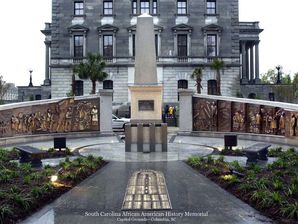
The South Carolina African American history memorial represents African American heritage in regards to the middle passage. It serves as a reminder of the history of African Americans in South Carolina.

Phase One: Pioneer Mining
The coal fields of Cherokee and Crawford Counties covered over 300 square miles of land, making it a prime area for coal mining. When early settlers first moved into the area in the 1800's, they were amazed to see the coal seams outcropping at the surface of the land. They could easily pick up the coal by hand to bring back to their homes as a source of energy.
Because of its shallowness, the coal was easy to remove. Pioneer mining was done on the surface with... Read More
University of North Carolina at Chapel Hill Undergraduate students in Grant Glass' Fall 2020 course, "Picture This": Principles of Visual Rhetoric, documented memorials on Indigeneity.
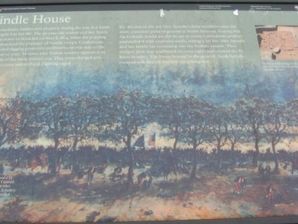
Many Spotsylvania families lost property during the war, but Sarah Spindle nearly lost her life. The 36-year-old widow and her family had just sat down to breakfast on May 8, 1864, when the popping of rifles announced the presence of hostile troops. Confederate soldiers started digging protective earthworks on one side of the farm (in front of you). Minutes later Union infantry appeared on the other side of the farm, behind you. They soon charged into Mrs. Spindle's yard and orchard.... Read More

In 1862 this farmhouse was home to the widow Sarah Watt, her granddaughter, Mary Jane Haw, and a maid. It was a typical Hanover County plantation of several hundred acres with some 28 slaves who produced a modest income from grains, potatoes, and livestock. Around the house stood a kitchen, slave quarters, and other outbuildings. A series of roads, now abandoned, connected the Watt family to their neighbors and Richmond.
Their lives drastically changed on the morning of June 27, 1862. The... Read More

Dedication: 17 November 1891
Architect: Adophus Druiding (1838- 1899), Chicago, IL
Contractor: Anton DeCurtins (1829- 1895), Carthegena, OH
This historic parish was organized in 1835 by a group of German
immigrants, primarily from Oldenburg, who purchased 40 acres of land.
In 1836, the parish was established from St. Augustine, Minster and became
the first catholic parish in Marion Township and Mercer County. The
present church is the third one after log (1837) and brick (1850) buildings.
The... Read More
Polish immigrants arrived in Detroit as early as the 1850s, but not until the Reverend Simon Wieczorek founded St. Albertus Roman Catholic Parish in 1872, did their community have a center. In 1885 the present Gothic Revival building replaced the original wooden frame structure. Inspired by the Reverend Dominic Kolasinski's concern for the Polish traditions, it incorporates twelve lunette panels over the nave arcades, brick detailing, and an octagonal tower common to churches in Poland.... Read More

Here, in 1747, at the
Tun Tavern
twenty-five gentlemen
of Philadelphia from that
part of Great Britain called
Scotland formed the . . . .
St. Andrew's Society
of
Philadelphia
Since that time, Scotsmen
of honor and integrity
have contributed toward
a charitable design to
provide for the relief of
distressed Scots after their
arrival in Pennsylvania