
Memorials
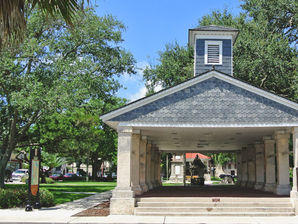
The St. Augustine Slave Market is a structure in which both Spaniards and the British governments sold slaves for hundreds of years..
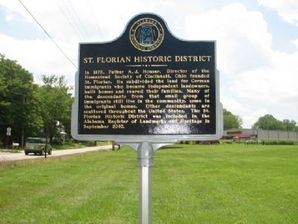
In 1872, Father A. J. Houser, Director of the Homestead Society of Cincinnati, Ohio founded St. Florian. He subdivided the land for German immigrants who became independent landowners, built homes and reared their families. Many of the descendants from that small group of immigrants still live in the community, some in the original homes. Other descendants are scattered throughout the United States. The St. Florian Historic District was included in the Alabama Register of Landmarks and Heritage... Read More

St. Hedwig's
In 1891, a wooden church was built and named St. Hedwig's for a queen of Poland. In 1904, the present-day structure was built and accommodated the growing congregation with seating for 700 people. Members of the congregation furnished labor and contributed artistic talent. Some families took out second mortgages on their farms to help pay for the cost of the new building.
Poznan Colony
As the lumber industry waned in the late 1880s, Polish land agents hoped to entice... Read More

The potato famine that ravaged Ireland in the late 1840s brought poverty and starvation to the Irish people. To survive, more than a million Irish fled their home coming to America on vessels so crowded and disease-ridden that they were termed "coffin ships.”
Hundreds of Irish immigrants came to Middletown. Many of the men took back-breaking, dangerous jobs in the brownstone quarries across the river in Portland, while the women often became domestic servants or took in laundry. Most of... Read More

St. John's German Cemetery —— ·•· —— St. John's German United Evangelical Church acquired this site in 1862 for its cemetery. Black Rock pioneers including War of 1812 veterans, German immigrants who began arriving in the 1840s, and their descendants through the mid 1920s were buried here. The cemetery was taken out of service in 1977, and those interred here were commemorated with a new monument in Elmlawn Cemetery, Tonawanda.

The first church at the town site of Cullman. Founded May 1, 1874, at the beginning of the second year of settlement.
An ethnic German church formed by immigrant families. Services held exclusively in the German language until 1932. In 1937, the Evangelical German churches merged with the Reformed churches and the national Evangelical and Reformed denomination was established. St. John’s became a part of the United Church of Christ in 1957.

Constructed by local parishioners, most of them
German immigrants from the Volga region of Russia
St. Joseph Parish began in 1876
Two earlier parish churches stood on this property
St. Joseph is the oldest church in continuous use in Hays
St. Joseph Church has been placed on the
National Register of Historic Places
by the United States Department of the Interior
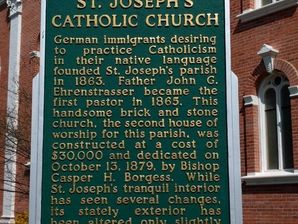
German immigrants desiring to practice Catholicism in their native language founded St. Joseph's parish in 1863. Father John G. Ehrenstrasser became the first pastor in 1865. This handsome brick and stone church, the second house of worship for this parish, was constructed at a cost of $30,000 and dedicated on October 13, 1879, by Bishop Casper H. Borgess. While St. Joseph's tranquil interior has seen several changes, its stately exterior has been altered only slightly in over a... Read More
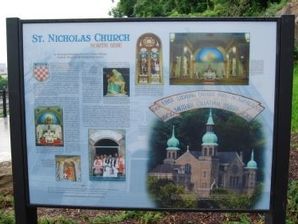
In the late nineteenth century, Croatian immigrants fled economic hardship and settled in Allegheny City (now Pittsburgh's North Side). The Croatian immigrants were predominantly peasants living in a region comprised of one faith, one nationality, and one language. Community leaders were concerned their people were in danger of neglecting church obligations as a result of a failure to adjust to new customs and petitioned the diocese to establish the first Croatian parish in the New World... Read More

About 500 feet northeast of this site, St. Nicholas Church was located in an area that was once the heart of a large Croatian community called Mala Jaska.
Croatian immigrants began settling in Allegheny City (now Pittsburgh's North Side) in the late nineteenth century, after their government deprived its citizens of political power, agricultural markets, and land ownership. Many of the immigrants were farmers from the Jaska region, where the economy was particularly hard hit by the... Read More