
Memorials
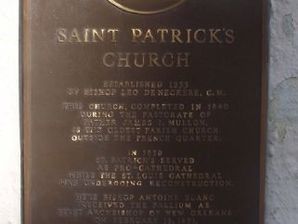
Established 1833
by Bishop Leo De Neckere, C.M.
This church, completed in 1840
during the pastorate of
Father James I. Mullon,
is the oldest parish church
outside the French Quarter.
In 1850
St. Patrick's served
as pro-cathedral
while the St. Louis Cathedral
was undergoing reconstruction.
Here Bishop Antoine Blanc
received the pallium as
first Archbishop of New Orleans
on February 16, 1851.
St. Patrick's is
reguarded as the mother church of
uptown New Orleans.

English:
Saint-Laurent Boulevard, commonly known as “The Main,” holds a special place in the emergence and development of cultural communities in Canada. Since the end of the 19th century, waves of immigrants from all around the world have stepped ashore at the foot of this 17th-century artery and , from there, moved onto the street and into Canadian society. Along this strong sinewy backbone of Montréal, in a kaleidoscope of neighbourhoods such as Chinatown, the Jewish and Portuguese quarters... Read More

Samuel Lincoln, ancestor of President Abraham Lincoln, and one of the eight early settlers of Hingham bearing that name, purchased this land in 1649. Seven generations of Lincoln descendants lived here.
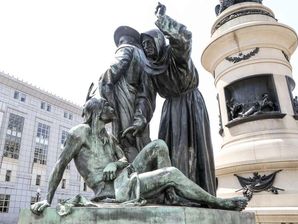
The San Francisco Pioneer Monument centers around a tall mable pedestal topped with a bronze statue of Athena, the Greek Goddess of Way, inset with bronze plaques and bas reliefs, and surrounded by three smaller statues depicting eras of California history.

Founded by German immigrants who settled as early as 1729. Initially served by traveling missionaries including John Caspar Stoever, Jr., first Lutheran pastor to visit regularly. A log structure was built about 1756; this church erected 1872. Named in honor of Peter Sattazahn, Revolutionary soldier buried here.

The Coastal Group, developers of the adjoining property have restored this brick water tower circa 1875 and have dedicated same to the borough in honor of those immigrants that were employed by the Brick Works and who through their toil, labors and work ethics built a solid foundation for this community.
Mayor John B. McCormack; Borough Council: Randy Corman, Alan W. Haac, Kennet Olchaskey John Pascucci, Jeffery Staniszewski, James L. Zagata.
Restoration by: The Coastal Group, Colts Neck,... Read More

Benvenuti
Welcome to
Schenectady's Little Italy
-------------------------------
This Gateway and Street are dedicated to Italian immigrants who came to Schenectady during the great European immigrations to the United States beginning at the end of the 19th Century. Driven by poverty, political unrest and war, New York and our nation offered a haven from despair, providing immigrants and their children hope and opportunity in a free and democratic country.
United by language and tradition... Read More

Swiss immigrant Josef Schmid began a mercantile business in Brenham in 1880. He was joined by his brothers Benjamin and Sigmund to form Schmid Bros. in 1889, and in 1899-1900 they erected this building to house their business enterprises. Built in the Renaissance Revival style, it features multi-bay configurations on both floors and round-arched windows with hood moldings. Sold by Schmid Bros. in 1934, it has remained a vital part of Brenham's business district.

German immigrant August Scholz (1825-1891) opened Scholz’s Hall at this site in 1866. About the turn of the century, this building replaced the original hall. A German social club, the Austin Saengerrunde, purchased the property in 1908 and added the adjacent hall. The Texas legislature honored Scholz Garten in 1966 as “A gathering place for Texans of discernment, taste, culture and erudition, epitomizing the finest traditions of magnificent German heritage in our state.”
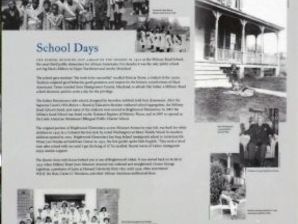
The School Building Just Ahead of You Opened In 1912 as the Military Road School, the area's third public elementary for African Americans. For decades it was the only public school serving black children in Upper Northwest and nearby Maryland.
The School gave students "the tools to be successful" recalled Patricia Tyson, a student in the 1950s. Teachers required good behavior, good grammar, and respect for the historic contributions of black Americans. Tyson traveled from... Read More