
Memorials

Erected by the Daughters of Utah Pioneers and the State of Utah as a replica of the Salt Lake Theater. Dedicated July 23, 1950, as a Hall in which to preserve the names, portraits, histories, manuscripts, relics and other evidences of wisdom, industry and culture of nearly 86,000 immigrant pioneers who, from 1847 until 1869, with ox team, handcart and on foot crossed a thousand miles of wilderness to find religious freedom and new homes in the Rocky Mountains.

Before you lies the massive Plott Balsam Range. On one of its eastern slopes Henry Plott, a German immigrant’s son, made his home in the early 1800’s. In this game-filled frontier, hunting dogs were a prized possesion. Here Henry Plott and his descendants developed the famous Plott Bear Hounds carefully selecting for the qualities of stamina, courage, and alertness the breed possesses today

Originally constructed as the stone house of German immigrant August Paunack, the structure was converted to an inn in 1858. It was extended toward the road by a twenty-five foot brick addition in the Greek Revival vernacular. Owned by Englishman John Whare during this period, it stood on Wiota Road offering sustenance and shelter to travelers to and from the southwestern part of the state.
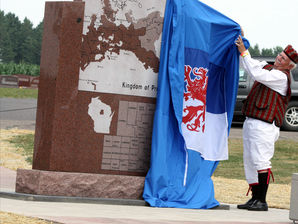
The granite monument celebrates the heritage of the Pomeranian immigrants that settled in Central Wisconsin, and the legacy that their presence in the region has left.

French immigrants established a community here in 1806. In 1814 it was surveyed and platted. By 1837 it was incorporated as a suburb of Louisville. It was an early port and boatbuilding center - 41 steamers had been built by 1855. Portland was site of first tramway in US, connecting it with Louisville, and once famous hostelry of South, St. Charles Hotel. Over.
Our Lady Church
Congregation organized in 1837 - 38 by Father Stephen Badin, the first priest ordained in U.S. He saw to Portland... Read More

Innovative use of native Dakota sandstone, a unique geological formation found only in this region, by pioneer Czech settlers can still be seen in our fencelines, farmsteads, civic & vernacular architecture, bridges, backroads, & byways.
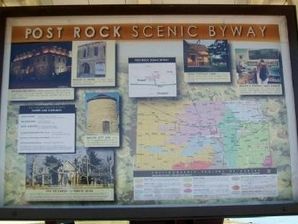
[History related excerpts from the marker]
Side A
The Midland Hotel
in Wilson was built in 1899 as the most magnificent facility in the Midwest. Featured in the 1973 movie Paper Moon, the hotel was recently restored back to its original splendour.
Wilson is Home
to many historic limestone buildings such as the Wilson Opera House Museum.
Wilson City Jail
circa 1911 is viewable year round. It was originally used for a water tower with the jail in the bottom.
Visit the Garden of Eden in Lucas... Read More

Pressed Steel Car Company provided worker housing at substantial cost to employees, keeping them in constant debt. During the 1909 McKees Rocks strike against the company, immigrant workers were evicted from their homes. The evictions led to the August 22 “Bloody Sunday Uprising” where at least 11 people died. The houses were sold after the company ceased operations in 1949. Constructed in 1899 as Schoenville, the neighborhood’s appearance remains similar to 1909.
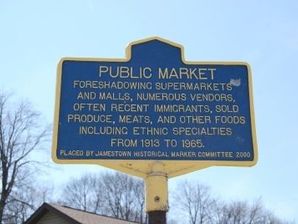
Foreshadowing supermarkets and malls, numerous vendors, often recent immigrants, sold produce, meats and other foods including ethnic specialties from 1913 to 1965.

In 1830, Congress passed the Indian Removal Act. David Crockett, Tennessee Congressman, and many others opposed the bill, yet it passed by one vote. This act displaced over 100,000 Native American Indians from 1838-1839. They were ripped from their ancestral homes in the Southeastern US and forced to move to a reservation 1,000+ miles away in modern day Oklahoma. Approximately 4,000 died on the routes. These routes are known as the Trail of Tears. Two of the paths passed through Giles County... Read More