
Memorials
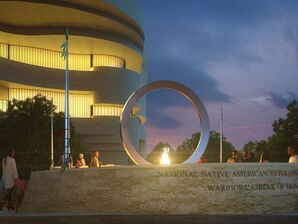
The National Native American Veterans Memorial honors the Native American soldiers who served in US military service, including American Indians, Alaska Natives, and Native Hawaiians.
"In proportion to their population, Native Americans serve in the military at a higher rate than any other ethnic group" (Capps).
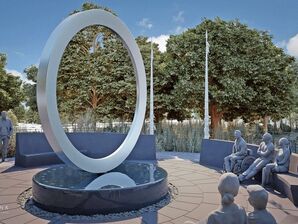
On the grounds of the Washington, D.C. Smithsonian’s National Museum of the American Indian, a National Native American Veterans Memorial has been established. This memorial recognized the enduring and distinguished service of Native Americans in every branch of the U.S. military for the first time on a national scale.
The memorial was established by the Smithsonian's National Museum of the American Indian after taking up the charge given by Congress in 1994 authorizing the NMAI a National Native American Veterans Memorial. The Memorial sits on the grounds of the museum on the National Mall in Washington, D.C. Its purpose is to honor the military service of the American Indian, Native Hawaiian, and Alaska Native veterans, who served in the armed forces.

This memorial is to commemorate Native American soldiers who served in the US Army and sacrificed since the revolutionary war.

Beginning in the late 1880's, this region of Prince George County along the Norfolk & Western Railway became the center of the first largest settlement of Czech and Slovak immigrants in Virginia. Originally known as Wells Station, then Estes, it was renamed New Bohemia in 1911 at the request of those settlers. Forming a community of homes, general stores, a church, hotel, school and neighborhood meeting hall, this small group of agrarian immigrants reclaimed and restored 12,000... Read More

In memory of the nearly 300 German immigrants who lost their lives when the sailing ship New Era wrecked off Deal Lake, November 13, 1854.
In honor of Abner Allen, Allenhurst's earliest settler, keeper of the local lifeboat house, and first rescuer to the scene of the shipwreck.
In solemn reverence of this disaster's role in establishing the U.S. Lifesaving Service, known today as the U.S. Coast Guard. It is hoped that this memorial shall inspire a permanent and prominent appreciation... Read More

"If I cannot be the citizen of free Germany,
then I would at least be a citizen of free America"
--Carl Schurz, German Revolutionary Leader, 1848
In 1848, a small group of immigrants from the Schleswig-Holstein area of Germany arrived here, then a remote wilderness, to found New Holstein. Seeking political freedom and economic opportunity, the group left Germany because of the failing struggle for democracy and opportunity in the new land. In 1847, Calumetville hotel owner and land... Read More

Side 1 The history of New Knoxville provides one of the best examples of chain migration to America. After the Shawnee were removed from what would become Auglaize County, James Knox Lytle, cousin to James Knox Polk, purchased land in Washington Township. Lytle platted a village of 102 lots in 1836, calling it Knoxville to honor his mother's family. Meanwhile, newly married Wilhelm and Elisabeth Fledderjohann Kuckhermann (later Kuck) immigrated from Ladbergen in northwest Germany. Having... Read More
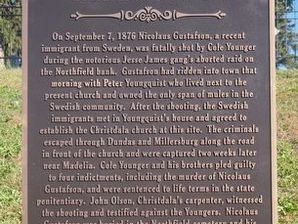
On September 7, 1876 Nicolaus Gustafson, a recent immigrant from Sweden, was fatally shot by Cole Younger during the notorious Jesse James Gang's aborted raid on the Northfield bank. Gustafson had ridden into town that morning with Peter Youngquist who lived next to the present church and owned the only span of mules in the Swedish community. After the shooting, the Swedish immigrants met in Youngquist's house and agreed to establish the Christdala church at this site. The criminals... Read More
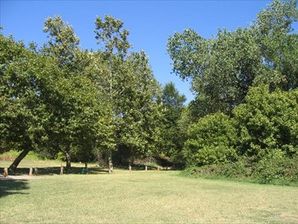
This is the site of one of the largest Indian villages and cemeteries in the Central Valley. No physical structures remain.