
Memorials

Side A:
Merion Village was named for the Nathaniel Merion family, who in 1809 settled what is now the South Side of Columbus on 1800 acres of the Refugee Lands. Entrepreneur William Merion operated “Merion's Landing” in the 1830s to capitalize on the canal trade from the Columbus Feeder Canal. This area saw a large influx of German immigrants as the South Side industrialized in the mid-nineteenth century. Later, many Irish, Italian, and eastern European immigrants who worked in the local... Read More

This memorial was placed in Miami in 1984 to honor the survivors of the Holocaust. It was placed in Miami because South Florida has one of the highest populations of Holocaust survivors in the United States. There are 20,000 - 25,000 survivors in this region of Florida. There was a decent amount of objection when creating this memorial because of the location as well as the idea that this memorial is religious and the concept of church and state. Many people thought that this memorial would... Read More

Fifteen German immigrants from Franconia, Bavaria, led by the Rev. August Craemer, founded Frankenmuth in 1845. They were advised to settle here by the Rev. Frederick Schmid, Lutheran pastor of Ann Arbor's German colony, founded in the 1820's. Other German agricultural villages were founded in the Saginaw Valley in the 1840's and 50's. Here, as in many other areas of Michigan, German settlers have contributed greatly to the state's cultural heritage.

The 1800s brought enormous change to Middletown, transforming its economy, its culture, and the very face of its people.
The changes began in 1807, when hostilities between the United States and Great Britain led Thomas Jefferson to ban international commerce. For Middletown, the result was disaster. The city's prosperity hinged on maritime trade which now decreased drastically. At the same time, many of Middletown's old farming families found there was not enough land left for their... Read More
University of North Carolina at Chapel Hill Undergraduate students in Grant Glass' spring 2019 English 105i course, "Writing in Digital Humanities," documented memorials in locations throughout the U.S. and Canada.

With the discovery of coal in Cherokee and Crawford Counties in the late 1860's, thousands came to work the mines. Some came from American towns and cities but most were immigrants from Europe. Over fifty nationalities settled in this area. Many landed at Ellis Island and continued here by railroad before heading out to the coal camps. Some came to find work. Some to escape repression. Some to find a new life in America. All were seekers.
What they found was not the "Paradise on Earth... Read More
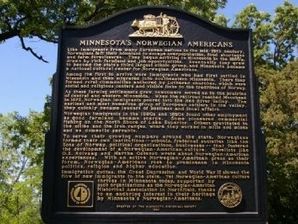
Like immigrants from many European nations in the mid-19th century, Norwegians left their homeland to escape overpopulation, food shortages, and farm foreclosures. They began arriving in Minnesota in the 1850s, drawn by rich farmland and job opportunities. Eventually they grew to become the state's third largest ethnic group, and Minnesota became a national cultural center for Norwegian Americans. Among the first to arrive were immigrants who had first settled in Wisconsin and then... Read More

Built in 1879, this Gothic Revival church stands two miles of this location. It contains an elaborate example of trompe-l’oeil fresco painting done in 1888. Joseph Dominick Phillip Oddenino, an Italian immigrant artist, painted to deceive the eye into believing that his plaster murals of Gothic arches, Renaissance-styled cornices, and embellished Corinthian columns were three dimensional. The ceiling is decorated with geometric designs.
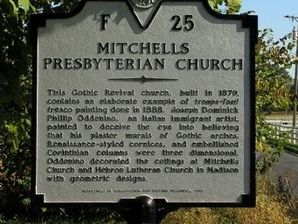
This Gothic Revival church, built in 1879, contains an elaborate example of trompe-l’oeil fresco painting done in 1888. Joseph Dominick Phillip Oddenino, an Italian immigrant artist, painted to deceive the eye into believing that his plaster murals of Gothic arches, Renaissance-styled cornices, and embellished Corinthian columns were three dimensional. Oddenino decorated the ceilings at Mitchells Church and Hebron Lutheran Church in Madison with geometric designs.

In Rapa Nui, the moai (statues) are sacred to the people and their identity. Carved from stone and wood, these statues are a source of mana, power and spiritual energy.