
Memorials

A rare surviving example of a quarantine station, the Lazaretto was the introduction to America for many immigrants. Established in 1799 in reaction to a yellow fever epidemic, it operated until 1893 to inspect cargo and passengers for infectious diseases. Affected cargo was fumigated or destroyed and ill passengers were hospitalized and quarantined until recovery or death. The cemetery was here and original structures remain nearby.

The Lenape Plaque was erected on Columbia University's campus to formally recognize the Lenape People's native heritage on Columbia University's land. This plaque symbolizes not only that Indigenous Peoples existed in the past, but remain prevalent components of campus and student life on university campuses.
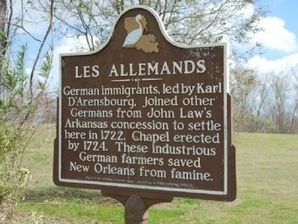
German immigrants, led by Karl D'Arensbourg, joined other Germans from John Law's Arkansas concession to settle here in 1722. Chapel erected by 1724. These industrious German farmers saved New Orleans from famine.
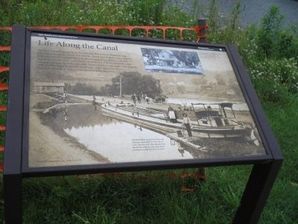
The building and operation of the 108-mile Delaware & Hudson Canal provided a multitude of jobs not only for Dutch and English settlers but for Irish and German immigrants. The area hummed with activity. Laborers dug the canal with picks and shovels, blasted rock with black powder, and cut and laid stone for locks and walls. Others tended locks, kept canal records, and cared for mules. Boatyards, blacksmith shops, gristmills, taverns, inns, and all kinds of stores soon appeared along... Read More

Jewish Historical Society of Greater Washington “The neighborhood was our whole life.” Albert Small, born in the neighborhood in 1902.
This is the oldest surviving synagogue building in Washington. Constructed in 1875 by Adas Israel Congregation, and originally located at Sixth and G Streets, it served the German-Jewish immigrant shopkeepers in the neighborhood. Albert Small, a member of the congregation, grew up on Fifth Street and recalled that as a boy, “the neighborhood was our whole life... Read More
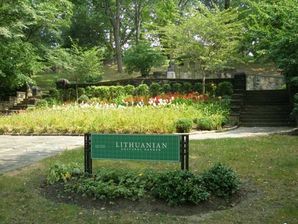
This memorial is dedicated to Lithuanian culture. It celebrates several historical figures revered as heroes due to their role in the independence of Lithuania, as well as those remembered fondly for their contributions to shaping Lithuanian culture.
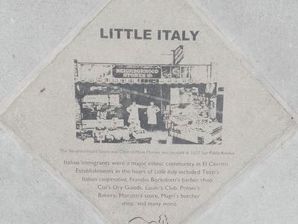
Italian immigrants were a major ethnic community in El Cerrito. Establishments in the heart of Little Italy included Tezzi's Italian cooperativa, Fandio Bortolotti's barber shop, Cisi's Dry Goods, Louie's Club, Poloni's Bakery, Morotti's store, Magri's butcher shop, and many more.

The Little Italy Landmark Sign was dedicated and lit at the 7th Annual Little Italy Festa on the evening of October 8, 2000. The landmark sign was constructed as a tribute to this immigrant neighborhood which, until the late 1960s, was the hub of the world's tuna fishing and canning industry. The nautical theme can be seen in the portholes at the top of the pillars, the blue neon of the lettering and the cable span which holds up the sign. The mosaic tile work on each side of the street... Read More

Established as a port of entry in 1706, this peninsula was originally known as Whetstone Point. Along this road in 1814, soldiers marched to the defense of Fort McHenry, nearby. Port facilities served as a Federal supply camp in the Civil War. Later received immigrant arrivals, and equipped “America’s Arsenal of Democracy” in World War II.

In 1858, the Lotz House was built on property purchased from Fountain B. Carter by German immigrant Albert Lotz, a master carpenter and piano maker. On November 30, 1864, before the Battle of Franklin, the Lotz family sought refuge across the street in the Carter House. When the Confederates broke through the Union defenses on Columbia Pike, they were halted by Union Col. Emerson Opdyke’s brigade, which was on both sides of the Pike, north of the Lotz House.