
Memorials

Koshkonong Prairie with its twin churches at both East and West Koshkonong is one of the focal points from which Norwegian Lutheranism spread to many parts of the American continent.
In 1844 at the request of pioneer Norwegian immigrants newly-ordained Johannes Wilhelm Christian Dietrichson came to Koshkonong from Norway. Under his leadership congregations were established and log churches built at both East and West Koshkonong. During his pastorate (1844-1850) Dietrichson traveled widely and... Read More
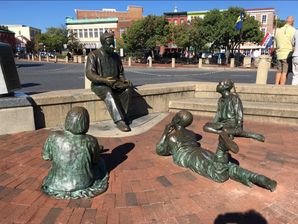
Located in Annapolis Harbor, the memorial includes a Statue of Haley, the author of Roots, alongwith three children. Commemorates the name and place of arrival of Haley's ancestor, an enslaved African named Kunta Kinte. Statues are accompanied by inscriptions telling the story of Haley's family history

Established by German immigrant Conrad Kupfrian (1833-1892), the 100-acre Kupfrian’s Park opened in the early 1880s and provided a distinctive entertainment and recreational venue for Pensacola residents for over thirty years. Kupfrian constructed amenities such as a German-style beer garden, a racetrack surrounding an infield lake, and numerous picnic pavilions nestled among his park’s large live oak trees. One of the park’s greatest contributions to the growth of Pensacola was its connection... Read More

By 1857, the Louisville & Nashville Railroad lacked only one connection for through trains to travel between the two cities—a bridge over Green River. Irish stonecutters John W. Key and sons were hired for two years to construct the piers that uphold the bridge, and German immigrant engineer Albert Fink designed and built one of his patented trusses. In its day, this bridge was the largest iron bridge in the United States, at 1,075 feet long.
The bridge’s true importance became evident... Read More
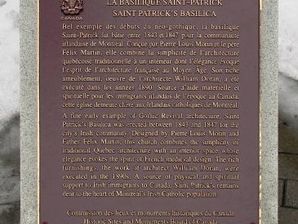
Bel exemple des débuts du néo-gothique, la basilique Saint-Patrick fut bâtie entre 1843 et 1847 pour la communauté irlandaise de Montréal. Conçue par Pierre-Louis Morin et le père Félix Martin, elle combine la simplicité de l’architecture québécoise traditionnelle à un intérieur dont l’élégance évoque l’esprit de l’architecture française au Moyen Âge. Son riche ameublement, oeuvre de l’architecte William Doran, a été exécuté dans les années 1890. Source d’aide matérielle et spirituelle pour les... Read More

First Church in Minnesota Organized by Mission Friend Immigrants from Sweden
1870-Organized on J.A. Skoglund Farm
1873-Built 1910-Enlarged
1870-1955 Served this Rural Parish
1961-Perpetual Care Fund Raised
1962-Dedicated to Covenant N.W. Conf. Work
Theo. J. Paulson
1916-1920 Pastor 1938-1955
Donated by Family
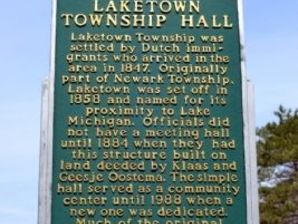
Laketown Township was settled by Dutch immigrants who arrived in the area in 1847. Originally part of Newark Township, Laketown was set off in 1858 and named for its proximity to Lake Michigan. Officials did not have a meeting hall until 1884 when they had this structure built on land deeded by Klass and Geesje Oostema. The simple hall served as a community center until 1988 when a new one was dedicated. Much of the original interior remains intact.

18 October 1587: the first recorded appearance of Filipinos on modern-day continental United States. Departing from Macao, China, they landed in present day California's Morro Bay as crewmen aboard Spaniard Pedro de Unamuno's galleon, Nuestra Señora de Buena Esperanza.

Near here at Harwood, on Sept. 10, 1897, immigrant coal miners on strike began a march for higher wages and equal rights. Unarmed, they were fired upon at Lattimer by sheriff's deputies. Nineteen marchers--Polish, Slovak, and Lithuanian--were killed. The majority of the dead were buried in St. Stanislaus Cemetery, Hazleton. Others were interred in St. Joseph's & Vine Street Cemeteries, Hazleton, and in St. Patrick Cemetery, McAdoo.

Here on September 10, 1897, nearly 400 immigrant coal miners on strike were met and fired upon by sheriff's deputies. Unarmed, they were marching from Harwood to Lattimer in support of higher wages and more equitable working conditions. Nineteen of the marchers were killed, and 38 were wounded. This was one of the most serious acts of violence in American labor history.