
Memorials

Here in 1881 Italian Swiss immigrants established an agricultural colony. Choice wines, produced from grape plantings from the old world, soon brought wide acclaim. By 1905, ten gold medals were awarded these wines at international competitions.

Italian immigrants were a small but cohesive segment of Richmond’s population by the 1850s. Local artist Ferruccio Legnaioli, who employed many Italian immigrant artisans, influenced the cityscape with his ornamental designs for the facades of prominent buildings early in the 20th century. In 1927 the Italian-American community gave the city a statue of Christopher Columbus, designed by Legnaioli and erected near Byrd Park. From the 1920s to the 1960s about 100 families, primarily from Tuscany... Read More

Norwegian immigrant John L. Buaas moved to Austin in 1839 and in 1872 was appointed city alderman by Reconstruction Governor E.J. Davis. In 1875 he built a mercantile store here. The two-story Italianate commercial structure was designed with two facades, one facing Pine (5th) Street, and the other on Pecan (6th) Street. Buaas sold the building in 1879, and since then it has been used for various commercial establishments and is now part of the revitalization of Old Pecan Street.

The son of German immigrants, Jacob Albright (1759 - 1808) founded the Evangelical Association, preached to poor farmers, and rose to become Bishop in the Methodist Church. His grave is nearby at Albright Memorial Church.
This is a statue that commemorates James Brendan Connolly, an American athlete and author who was the son of Irish immigrants.

This vernacular Greek Revival style, side-gabled house is significant as an example of a style locally popular between 1830 and 1860. One of the few remaining houses of the "stagecoach inn" design characteristically being two bays wide and five bays deep, the original building was executed in red brick and a later 1930s addition was constructed in lighter brick. The house was used by the Doris family as a boarding house for Irish immigrants and is significant for its association with... Read More

First Register of deeds of Sevier County, Tennessee, in 1796, James McMahan set aside the original twenty-five acres for the creation of the township at "The Forks of The Little Pigeon" in 1795. An immigrant from Ireland, McMahan was married to Rachel Calvert (1770-1840), a descendant of George Calvert, Lord of Baltimore, They made Sevier County their home, rearing their thirteen children on their vast farmland along the east prong of the Little Pigeon River including this site of... Read More
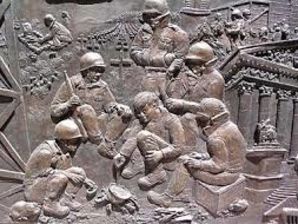

This memorial is dedicated to remembering the hardships of the thousands of Japanese Americans that were sent to interment camps during WWII due to the racially-oriented suspicion that they were all spies.