
Memorials

Low Memorial Library acts as the centerpiece for Columbia University and memorializes the Pantheon in Rome and the intense influence of Greek architecture. The architects designed the Library's great dome ceiling to embody a luminous moon and the building has been the heart of various ceremonies and student gatherings.

Chief Carver on Mount Rushmore
1933-1940
"He is worth any three men in America for this particular type of work"
Designer Gutzon Borglum
A Proud Port Chester Resident
1892-1969

The first college founded by Norwegian Lutheran pioneer immigrants in the United States opened in the parsonage of Halfway Creek Lutheran congregation, Sept. 1, 1861. Teachers were Laur. Larsen and F.A. Schmidt, who also served as pastors for area immigrants. Enrollment was 16. The parsonage was destroyed by fire in 1865. The site and a marker are one-half mile west of Halfway Creek Lutheran Church on Knutson Road, near Halfway Creek Cemetery. The College moved to Decorah, Iowa, in 1862 where... Read More
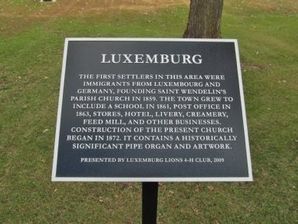
The first settlers in this area were immigrants from Luxembourg and Germany, founding Saint Wendelin's Parish Church in 1859. The town grew to include a school in 1861, post office in 1863, stores, hotel, livery, creamery, feed mill, and other businesses. Construction of the present church began in 1872. It contains a historically significant pipe organ and artwork.
Presented by Luxemburg Lions 4-H Club, 2009

Tampa's first Italian–American society
was organized April 4, 1894. During its
early years the club assisted members
through cultural enrichment, providing
education, health care and financial help
to the families of deceased members.
L'Unione Italiana has made a lasting
contribution in preserving the colorful
ambiance of Italy, which enriches the
cultural life of the Tampa community.

Original location of the Macedonian Tribune, 20 South West Street, from 1927-1949. Founded by immigrants from Macedonia as the voice of the Macedonian Patriotic Organization, the paper continues to be published in Fort Wayne, Indiana.
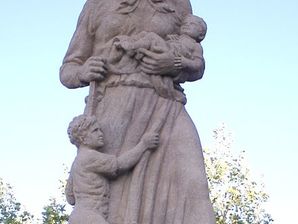
These identical sculptures were placed in the 12 states along the National Old Trails Road. The monuments were commissioned by NSDAR and created by August Leimbach. They are meant to celebrate the spirit of pioneer women in the United States during westward expansion and to provide a symbol of courage and faith.

Between 1890 and 1910, the highway corridor where you are now standing developed into a Croatian community known as "Mala Jaska" (or Little Jastrebarsko), after the town from which many of the immigrants came. The area was initially settled by German and Swiss immigrants who established tanning, lumber, brewing, and metals production concerns. Industrial and residential growth flourished between 1840 and 1880, aided by several transportation improvements: the Pennsylvania Canal (1829... Read More

Panel 1:
The City and Borough of Juneau Assembly Honors the Contributions of Filipinos in Juneau by naming this downtown location MANILA SQUARE
Juneau Assembly Members: Dale Anderson - Don Etheridge, Jr. - Jeannie Johnson - Ken Koelsch
Frankie Pillifant - Jim Powell - Randy Wanamaker - Marc Wheeler
John Mackinnon, City Manager -- Sally Smith, Mayor
Filipino Community of Juneau:
Dannie Lazaro, President, 2002 – Morris Carrillo, President, 2003
August 19, 2002
[Bust of Dr. Jose P. Rizal,... Read More
Mantle Rock - 1/2 mile. During winter of 1838-1839, the Cherokees were forced to leave their Smoky Mountain homes for Oklahoma territory. Mantle Rock, a 40-foot sandstone arch, was used for shelter on their "Trail of Tears." Since the icy Ohio River had no ferry traffic, the Indians sought cover beneath the arch. Many died there. Mantle Rock was also campsite for ancient Indians