
Memorials

On this site, in May 1852, a group of Shasta merchants met with William H. Noble to employ him as a guide over a direct route he had marked as an immigrant trail. This meeting resulted in the establishment of the Noble's Trail.
Rededicated April 27, 1985 by Trinitarianus Chapter No. 62, E Clampus Vitus.

This monument was erected to memorialize....
30 foot diameter circle made of concrete. A 15-foot high steel arch A bronze plaque Tuscorora engraved on the left side and Nooherooka on the right.

North Carolina Historical Highway Marker commemorating the first English settlers to create a permanent settlement in Jamestown, Virginia in 1607. There were 105 settlers when they made landfall.

Norway Colony Site of first Norwegian settlement in America, 1825. The "Sloopers" were the first immigrant group to travel on the completed Erie Canal.
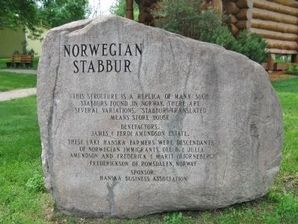
This structure is a replica of many such stabburs found in Norway. There are several variations. "Stabbur" translated means store house.
Benefactors: James & Ferdi Amundson estate.
These Lake Hanska farmers were descendants of Norwegian immigrants, Ole B. & Julia Amundson and Frederick & Marit (Bjorneberg) Frederickson of Romsdalen, Norway.
Sponsor: Hanska Business Association

Carl Nowack, an immigrant and Civil War veteran, built a traditional German half-timber farmhouse near the south shore of Random Lake in 1865. The Village of Random Lake grew up around this first residence. In 1998, the Random Lake Historical Society formed to dismantle and rebuild his house at the present location.

The Ocmulgee National Monument, also known as the Ocmulgee mounds, is a 702-acre monument made up of grass mounds. In 1934, the land was classified as the Ocmulgee National Monument and in December of 2016 the mounds were declared a National Treasure. The land was first settled by Native Americans 17,000 years ago and is of particular significance to the Musogee Nation.
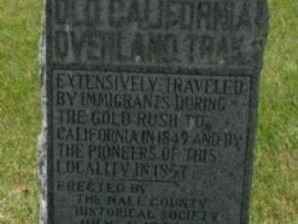
Extensively traveled by immigrants during the Gold Rush to California in 1849 and by the pioneers of this locality in 1857.

Erected in 1932, this monument commemorates the treaty in which the Chippewa Indians ceded their rights to the Red River Valley in Minnesota to the US. The Treaty of Old Crossing (1863) was a forced treaty in order to serve the business interests of the local and national government. This treaty allowed for businesses, most notably transportation companies, to pass through the Chippewa territory (specifically the Pembina Trails) and compensated Chippewa by allocating $20,000 per year for 20... Read More