
Memorials
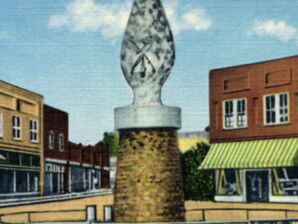
Originally the monument was dedicated to the pioneers who founded Old Fort in North Carolina, but now represents the peace between the English settlers and the Catawba and Cherokee Native American tribes.

We honor the earliest interments of our pioneers whose wooden crosses, slabs and markers have been destroyed by the erosion of time. They were immigrants and adventurers who answered the call of gold. Some stayed to become packers, merchants, farmers and warriors. Their courage and tenacity overcame hardships forging the community we have today.

Old Stagecoach Inn
This historic inn began serving travelers on the old Portage-Columbiana stage road (now Tallmadge Road) in 1832. Two major stage lines, one from Cleveland to Wellsville (the closest Ohio River port) and the other from Cleveland to Pittsburgh, passed through Palmyra in the early 1800s. Originally a simple two-story Greek Revival-style building, it had its third story added in 1888 when it became a lodge for the Knights of Pythias fraternal organization. It served as a private... Read More

Settled in the 1850s by German immigrants, this area was virtually destroyed by the Fire of 1871. Most of these wood cottages and brick and stone townhouses date to the last decades of the 19th century. After World War II, this area became the focus of one of the city’s earliest neighborhood conservation efforts.

Swedish immigrant Johanna Olson (1835-1914) purchased this property in 1907 after she returned to the Round Rock area upon the death of her husband, Johannes, in 1894. Local contractor A.S. Robertson built this house for her in 1908, and it remained in the Olson family until 1944. Johanna and her daughters took in boarders from nearby Trinity College during its existence from 1906 until 1929. A good local example of Queen Anne architecture, the Olson House features classic elements of that... Read More

Imagine standing on this corner between the late 1800s and late 1960s. What would you see? You would be surrounded by rowhouses, apartment buildings, small businesses, and streetcars rattling down G Street toward Union Station. The homes were occupied by a rich mix of families - Jewish, Irish, Chinese, Italian, Russian, Greek, African American, and German. Holy Rosary Church, completed by Italian immigrants in 1923, stood a half-block south at Third and F Streets. The suburbanization, freeway... Read More

The son of Cuban immigrants, Oscar Hijuelos lived here from 1951 to 1971, where he first began to write and play guitar and piano. Literature and music would be his life-long passions. A student at Bronx Community College, Manhattan Community College, and Lehman College before entering the City College of New York where he received his B.A. and M.F.A., he was the recipient of The Rome Prize for his first novel, Our House in the Last World (1983). Hijuelos became the first Latino to win the... Read More

A German-Swiss settlement, 4 miles southeast, started by immigrants, early 1880s. Guided here by Joseph Ottenheimer "to this land of great opportunity" they found it to be a wilderness. Undaunted they built crude log cabins, then cleared the virgin land and developed it into a highly productive agricultural area. By 1886 a Lutheran and a Catholic Church had been built.

This property has been
placed on the
National Register
of Historic Places
by The United States
Department of The Interior