
Memorials

(Side One)
Overisel
Seeking religious liberty and better economic opportunity in a new land, the Reverend Seine Bolks and a congregation of about two dozen families, left Hellendoorn, Province of Overisel, The Netherlands, on August 18, 1847. The group wintered in Syracuse, New York, before continuing its journey to “Black Lake County” (present-day Lake Macatawa) in Michigan. The Overisel settlers joined Dutch immigrants in the Holland settlement in June, 1848. They selected land and pooled the... Read More

This memorial is to commemorate Americans and Filipino armed forces who sacrificed during the Second World War.

c. 1712
First Road West By
German Refugees To
Schoharie Valley
English
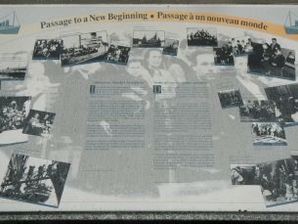
Celebrating Canada’s Immigrants
In the 1940s and 1950s, Canada opened its doors wide to European immigrants. With haunting wartime memories still fresh in their minds, men, women and children from diverse countries and cultures arrived at Halifax, Saint John and Quebec City.
After a voyage of a week or more across the North Atlantic many disembarked confused and exhausted, clutching their worldly possessions. Some were eager to explore their new country, while others faced a new world... Read More

103 Berrellesa
Old Town Martinez
Home of Historic Interest
Pellegrini Home and Fish Company
Luigi Pellegrini was a successful turn of the century fish buyer. This building opens to Alhambra Creek for easy fish unloading and contains the only 100 year old fish ice box on the West Coast. Circa 1890

The Schoen building is significant as an excellent example of an Italianate style commercial building from Madison's earliest commercial era. Constructed of local sandstone and designed by one of Madison's most influential architects, the building features an original cast iron storefront at the ground floor. Characteristics of the Italianate style are evident in the tall upper story windows featuring segmental arched, stone window hoods and similarly arched wood sash windows. This... Read More

English
When the Canadian immigration complex known as Pier 21 closed its doors in March of 1971, it marked the end of a more than forty-year saga of human hope, vision, courage and resilience. From its opening on the Halifax waterfront in 1928 to its final months of operation, Pier 21 served as a bridge to new beginnings. More than a million immigrants, refugees, displaced persons and war brides passed through its transit shed on their way to becoming Canadian citizens. During the Second World... Read More

There are three plaques on this monument.
Pier 21 / Le Quai 21 English
This site witnessed the arrival of approximately one million immigrants, who have enriched the cultural mosaic of Canada. Opened in 1928, Pier 21 served as one of Canada’s principal reception centres for immigrants until it closed in 1971. It typifies the large, self-contained immigrant facilities that the Government of Canada had begun to establish at major ports near the turn of the 20th century. The staff at Pier 21... Read More

The first twenty-three families of Volga-Germans arrived in Victoria on April 8, 1876, and established the Village of Herzog in the area north of this point. The first religious activities of these settlers centered around the Village Cross. In the following months and years they were joined by many more Volga-German immigrants. The community outgrew three church buildings before the present church was completed in 1912. This statue, a tribute to these pioneers, was dedicated July 28, 1976.