
Memorials

Moravian immigrant Johann Neusser came to Texas in 1872 and settled in Fayette County. In 1881, he and a number of fellow immigrants moved their families to this area. The Georgetown and Granger Railroad Company built a line through Neusser’s land in 1890, and soon a general store and dance hall were built on the rail line. Initially surveyed as Keliehor for another area landowner, the community officially was named Neusser in 1892 when a post office was established. The construction of a depot... Read More
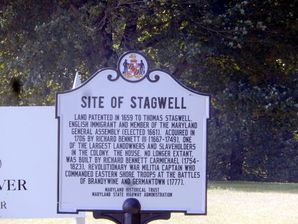
Land patented in 1659 to Thomas Stagwell, English immigrant and member of the Maryland General Assembly (elected 1661). Acquired in 1706 by Richard Bennett III (1667-1749). One of the largest landowners and slaveholders in the colony. The house, no longer extant, was built by Richard Bennett Carmichael (1754-1823), Revolutionary War militia captain who commanded Eastern Shore troops at the Battles of Brandywine and Germantown (1777).

The Fenton Guards, organized in 1875 by Swedish immigrants, was the local national guard unit which occupied the first armory here in 1888.

First public water well in the city of Sonora and located on the perimeter of the early day plaza that was established by the Mexican immigrants as Sonora Camp. The well has its source in a spring underground at the northwest corner of the Bank of America.

Robert M. Jones of Wales, who came here in 1848 as an immigrant, began the slate quarrying industry. The region became a major world center for slate. From here came slate for roofs and old-time school slates and pencils.

One of the largest slate-producing centers in the United States. Welsh slate entrepreneur William Roberts first sighted slate in 1844 near a local barn. He and other Welsh immigrants established and worked in numerous slate quarries in this region. Nearby quarries included "Big Franklin"( c.1852), the largest excavation in Slatington; and "Williams," known for its production of school slate. These sites also contributed to the increase of slate roofing during the late 19th... Read More
The garden reflected the culture of Cleveland’s Croatians, Serbians, and Slovenians. They had conflicted pasts and this garden symbolized peace between the groups.

This tablet is the
Property of the State of Colorado
——
Here was the end of the famous Smoky Hill Trail
Immigrant and stage road extending
from the Missouri River to Denver.
Traversed by pioneers in 1858.
Surveyed by W.G. Russell in 1860.
Route of Butterfield's Overland
Despatch and Wells Fargo Express.
The trail took its human toll -
Death by thirst and Indian raids.

The Soldierstone memorial is a 10-foot granite memorial that sits atop a mountain range in Saguache, Colorado. It was planned and created by a Vietnam war veteran, Stuart Allen Beckley. The memorial was made to honor the civilians and soldiers of those from nations who secretly aided the United States during the Vietnam war -- including Vietnam, Laos, Cambodia, and France. Beckley's wish was to keep this memorial in a peaceful, remote area, where the memorial would have a quiet existence and... Read More

Founder of the family-owned department store chain. An immigrant from Russia, 1911, he came to Reading as a peddler. His first store began here after WWI and gradually expanded. New stores opened starting in 1962. In 1969 he died; thirty years later, Boscov's had 34 stores in five states.