
Memorials

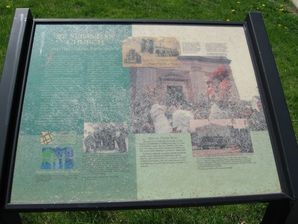
The first Croatian Catholic parish in America was established in 1894. The 1901 church was a center for spiritual and social Croatian culture. Croatian immigrants fled religious, economic, and political oppression to pursue new lives in Pittsburgh. Its familiar geography and economic opportunities attracted many Croatians. Despite a 14-year preservation effort, the modified Romanesque church and grotto were razed in 2013.

Parish was the second
established in New Orleans
The first church on this
site was dedicated April 21,
1833 The cornerstone of the
present edifice was laid
July 1, 1838, by Bishop Antoine
Blanc. During the pastorate
of Father James I. Mullon
the first service in the
completed church was held
February 23, 1840 The
building was designed by
Dakin and Dakin, architect
and completed under the
direction of the architect
James Gallier who designed
most of the interior, including
the high altar. The... Read More

Completed in 1850, St. Patrick's served as the seat of all Roman Catholic bishops and archbishops of Newark from the establishment of the diocese in 1853 until completion of Sacred Heart Cathedral in 1954. St. Patrick's, third oldest parish in Newark, was founded by Irish Immigrants. The Gothic Revival church, designed by Patrick C. Keely, was consecrated on March 17 (St. Patrick's Day) in 1875. Listed on National Register of Historic Places in 1972.

This church was built by the Pallotine Fathers in 1843 to commemorate Italian immigrants. The church was designed by Irish architect Sir John Miller-Bryson.

St. Peter's UCC Completed in 1857 by a group of immigrants from Germany, services were held in German until 1929. Church moved from road in 1980.
Immigrants from Italy settled in Middletown as early as the 1860s, and for several decades the Italian population here increased slowly. Then, at the turn of the 20th century, the trickle of immigrants became a virtual flood. Hundreds of families from the small town of Melilli, Sicily began arriving in Middletown and soon created a strong, close knit community.
The story of the Melillese emigration began with Angelo Magnano, who came to America from Melilli in the 1880s, and settled in... Read More

Coming to Maryland in 1868, the first major influx of Poles settled at Fells Point where, at 223 S. Bond Street beginning in 1877, they conducted their religious services. Under Rev. Peter Koncz (1839-1886), they organized the Parish of St. Stanislaus Kostka in 1879 and dedicated this church on 26 June 1881. Since 1905, this parish has been under the care of the Franciscan Conventuals who continue to help Polish immigrants to adjust to American life. Dedicated November 6, 1988
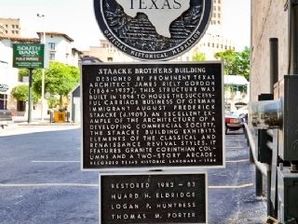
Designed by prominent Texas Architect James Riely Gordon (1864-1937), this structure was built in 1894 to house the successful carriage business of German immigrant August Frederick Staacke (d.1909). An excellent example of the architecture of a developing commercial society, the Staacke Building exhibits elements of the classical and renaissance revival styles. It features granite Corinthian columns and a two-story arcade.
Restored 1982 – 83
Huard H. Eldridge
Logan P. Huntress
Thomas M.... Read More

One of the world's largest coke producing centers operated here from 1883 to 1931. H. C. Frick Coke Company's more than 900 beehive ovens consumed thousands of tons of coal daily. The company publicized itself by exhibiting a scale model of Standard Shaft Number 2 at Chicago's Columbian Exposition in 1893. The largely immigrant work force, exemplary in its productivity, helped shape the culture of the region.

This simple brick dwelling was built for Frederick Stang, a Bavarian immigrant and market gardener. His house is one of the last vestiges of these early-day fruit and vegetable farms on the fringes of the city. In 1883, a later owner, Jacob Wirth, also from Germany, enlarged the house substantially. The brick for the house is believed to have come from a brickyard that was located at the west corner of Milwaukee and North Streets and East Washington Avenue.