
Memorials

Twice in the 20th century, Baltimoreans completely reinvented their downtown-by necessity in the early 1900s and by plan mid-century.
In 1904, Baltimore’s downtown vanished when 140 acres were destroyed by fire. Within ten years, Baltimore had replaced approximately 1,500 burned-out buildings with 750 much larger structures. Several of Baltimore’s most significant institutions relocated to this intersection, the central crossroads of the City.
Directly north of Baltimore Street, the... Read More

“The turnpike bridge at Funkstown is the only one...which seems to belong to a town” —Helen Ashe Hays, The Antietam and its Bridges
This bridge, finished in 1823, is perhaps the oldest one over Antietam Creek. Irish immigrant laborers made up the construction crew. Many worked on the road to pay off the cost of their passage from the old country, what they called “working to pay off the dead horse.” The “great brigade” of Irish leveling the roadway and breaking rocks caused one traveler to... Read More
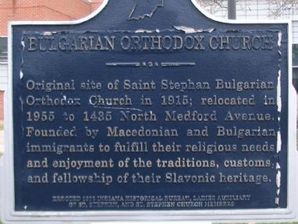
Original site of Saint Stephan Bulgarian Orthodox Church in 1915; relocated in 1955 to 1435 North Medford Avenue. Founded by Macedonian and Bulgarian immigrants to fulfill their religious needs and enjoyment of the traditions, customs, and fellowship of their Slavonic heritage.
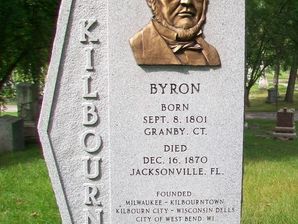
(Front)
Founded
Milwaukee - Kilbourntown
Kilbourn City - Wisconsin Dells
City of West Bend. Wi.
Kilbourn Lodge 3
F. & A. M.
(Back)
In 1998 Historic Milwaukee Inc.,
brought Byron Kilbourn
back to the city.
With grand civil ceremony
he was buried here
on December 16, 1998
"The fertility of the soil,
the salubrity of the atmosphere...
A most inviting country
to the immigrant."
Byron Kilbourn to
Senator Louis Linn
of Missouri. 1835
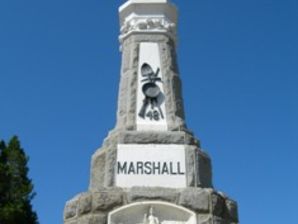
This monument was erected to memorialize John Marshall, the miller who found gold in the tail-chase of Sutter's Mill.

This site marks the spot where gold was discovered by John Marshall at Sutter's Mill in 1849.

Founded in 1853, this neighborhood was the first home to immigrants who came to Johnstown to find work in the coal mines and steel mills. Nationality churches and ethnic clubs exemplify the neighborhood's rich and diverse culture.

A large granite cross with a plaque that commemorates the first landing spot of the English colonists who would go on to settle Jamestown.

Sacred
to the memory of
187
Irish Immigrants
from Sligo
wrecked here
on April 28th 1847
Ship Carricks
of Whitehaven
87
are buried here
Pray for their souls
Erected by
Parishioners of St Patricks
Parish Montreal
Rev. J. Quinlivan P.P.

Charles Carroll of Carrollton (1737–1832), the last surviving, and only Roman Catholic signer of the Declaration of Independence, wintered here during the last twelve years of his life.
Built circa 1808, the mansion is the grandest Federal era (1780–1820) merchant’s townhouse standing in the City of Baltimore today. The ground floor was used for business and family gatherings, the second for formal entertaining, and the third for sleeping.
The mansion was sold to the Sisters of Mercy, who had... Read More